Technical
Why PSC Codes Matter More Than NAICS When Researching Federal Contracts
Most government contractors know their NAICS codes by heart. Ask any small business owner pursuing federal work, and they can rattle off their primary codes without hesitation. It's practically a rite of passage in the GovCon world.
Far fewer understand their Product Service Codes—and that gap quietly breaks a lot of federal contract research.
I learned this the hard way while building FedProposal. When I first started pulling data from USAspending and FPDS, I built everything around NAICS codes. That's what everyone talks about. That's what SAM.gov emphasizes. That's what every certification program revolves around. It seemed obvious.
It wasn't until I started doing serious market research—trying to find expiring federal contracts, understand incumbent landscapes, and track agency buying patterns—that I realized NAICS was only telling me half the story. Sometimes less than half.
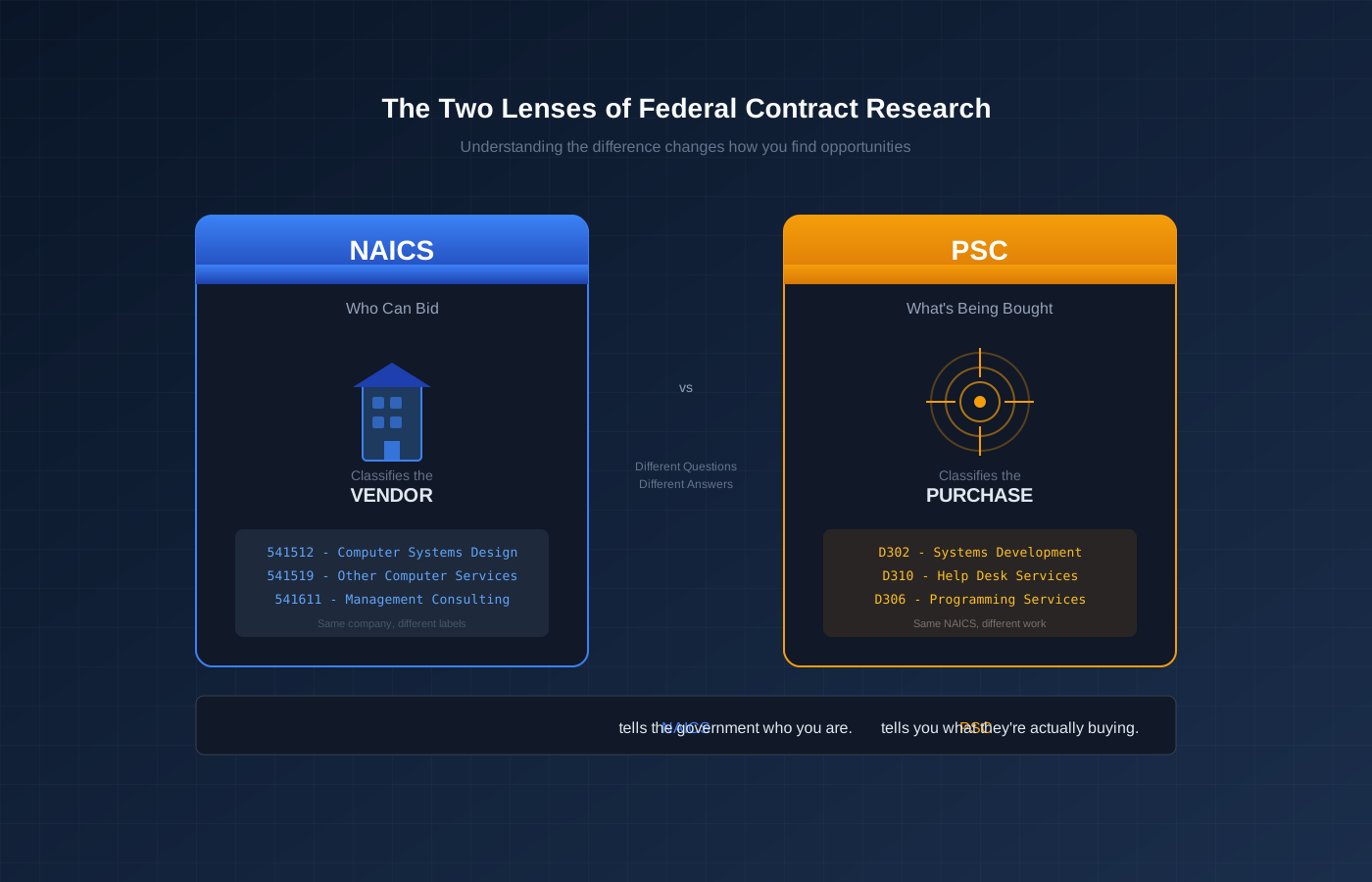
NAICS tells the government what kind of business you are. PSC tells the government what it's actually buying. When you're researching expiring contracts, incumbents, and recompetes, that distinction matters more than most contractors realize.
If you rely only on NAICS codes to find opportunities, you'll miss relevant contracts, misunderstand competition, and draw the wrong conclusions about an agency's buying behavior. This article explains why PSC codes matter, how they differ from NAICS, and how using both together gives you a much clearer picture of the federal market.
Most government contractors know their NAICS codes by heart. Ask any small business owner pursuing federal work, and they can rattle off their primary codes without hesitation. It's practically a rite of passage in the GovCon world.
Far fewer understand their Product Service Codes—and that gap quietly breaks a lot of federal contract research.
I learned this the hard way while building FedProposal. When I first started pulling data from USAspending and FPDS, I built everything around NAICS codes. That's what everyone talks about. That's what SAM.gov emphasizes. That's what every certification program revolves around. It seemed obvious.
It wasn't until I started doing serious market research—trying to find expiring federal contracts, understand incumbent landscapes, and track agency buying patterns—that I realized NAICS was only telling me half the story. Sometimes less than half.
NAICS tells the government what kind of business you are. PSC tells the government what it's actually buying. When you're researching expiring contracts, incumbents, and recompetes, that distinction matters more than most contractors realize.
If you rely only on NAICS codes to find opportunities, you'll miss relevant contracts, misunderstand competition, and draw the wrong conclusions about an agency's buying behavior. This article explains why PSC codes matter, how they differ from NAICS, and how using both together gives you a much clearer picture of the federal market.

What NAICS Codes Are (and What They're Good For)
The North American Industry Classification System, or NAICS, is a standardized framework that classifies businesses by their primary industry. It's a shared system across the United States, Canada, and Mexico, designed to help governments collect and analyze economic data.
In federal contracting, NAICS codes serve several important purposes. They determine small business size standards, which vary by industry. A small business in construction has a different revenue threshold than a small business in IT services. NAICS is the mechanism that makes those distinctions.
NAICS codes also establish eligibility for set-asides. When an agency decides to reserve a contract for small businesses, 8(a) firms, service-disabled veteran-owned small businesses, HUBZone companies, or women-owned small businesses, the NAICS code determines who qualifies. Your status as a "small business" isn't universal—it's tied to specific NAICS codes based on your revenue or employee count.
Beyond eligibility, NAICS codes define who can compete for a given solicitation. When a contracting officer assigns a NAICS code to an opportunity, they're making a determination about the competitive landscape. That decision directly affects which companies are eligible to pursue the work.
This makes NAICS essential for several things. You need NAICS codes to register in SAM.gov. You need them for certification programs like 8(a), SDVOSB, HUBZone, and WOSB. You need them for compliance and eligibility checks throughout the acquisition process.
But here's the critical limitation: NAICS is about vendor classification, not the work itself.
A company classified under NAICS 541512 (Computer Systems Design Services) might perform cybersecurity assessments, software development, cloud migration, help desk support, or a dozen other things. The NAICS code tells you about the company's business. It doesn't tell you what the government is actually buying on any given contract.
What PSC Codes Are (and Why They're Different)
Product Service Codes, or PSCs, describe the actual products and services the federal government purchases. While NAICS classifies the seller, PSC classifies the purchase.
PSC codes are structured hierarchically. The first letter indicates the broad category—"D" for automatic data processing and telecom services, "R" for professional, administrative, and management support services, "J" for maintenance, repair, and rebuilding of equipment. Subsequent characters provide increasing specificity.
This structure lets you answer questions that NAICS simply can't. Is this contract for IT development or IT operations? Is this advisory support or engineering services? Is this research and development, maintenance, training, or logistics? Two contracts with identical NAICS codes can have completely different PSCs, scopes, and competitive landscapes.
Consider a practical example. A contract under NAICS 541519 (Other Computer Related Services) could carry PSC code D302 (IT and Telecom Systems Development Services) or D310 (IT and Telecom Help Desk/Information Support Services). Same NAICS code, radically different work. One involves building systems, the other involves operating them. The skill sets are different, the pricing models are different, the competitive dynamics are different.
PSC codes are attached to individual contract awards, task orders, modifications, and spending history. That makes them far more precise for market research. When you're trying to understand what an agency actually buys—not just which types of companies they hire—PSC is your primary tool.
The Problem with NAICS-Only Research
Here's what typically happens when contractors rely exclusively on NAICS codes for market research.
They start with their primary NAICS codes—the ones on their SAM.gov registration, the ones tied to their certifications. They search for opportunities and historical awards using those codes. They build a picture of the market based on what they find.
The problem is that picture is incomplete and often misleading.
Missing relevant contracts. Agencies don't always assign the NAICS code you'd expect. A cybersecurity contract might be coded under 541512 (Computer Systems Design Services), 541519 (Other Computer Related Services), or even 541990 (All Other Professional, Scientific, and Technical Services) depending on how the contracting officer characterized the requirement. If you're only searching one NAICS code, you'll miss opportunities coded under the others.
Misunderstanding competition. When you search by NAICS, you get a broad view of who's working in that space. But that doesn't mean you're actually competing against all those companies. A firm doing software development under NAICS 541512 isn't necessarily competing with a firm doing network engineering under the same code. The PSC tells you who's actually doing work comparable to yours.
Misjudging pricing. Historical pricing data is only useful if you're comparing apples to apples. Contracts with the same NAICS code but different PSCs can have wildly different cost structures. Using NAICS-based pricing analysis can lead you to bid too high (losing the competition) or too low (eroding your margins or raising red flags).
Overlooking incumbents. This is perhaps the most dangerous mistake. Your real competitors—the companies you'll face on recompetes—might operate under different NAICS codes than you. But if they have the same PSC codes, they're doing the same work. NAICS-only research systematically misses these competitors.
Why PSC Codes Matter for Recompetes and Expiring Contracts
When you're tracking expiring contracts, you're not just asking "What industry is this?" You're asking "What work is being recompeted?"
That's a PSC question, not a NAICS question.
Expiring contracts represent some of the most valuable intelligence in federal contracting. They tell you what agencies are about to buy, what they've paid historically, who's been doing the work, and how satisfied they've been with the results. But that intelligence is only useful if you can accurately identify which contracts are relevant to your capabilities.
PSC codes let you see patterns in what agencies actually buy. You can track how much an agency spends on specific types of services over time. You can identify whether that spending is increasing or decreasing. You can see whether they're consolidating requirements or breaking them into smaller pieces. None of that is possible with NAICS alone.
PSC codes also let you identify clusters of similar contracts across offices. A large agency like DOD or HHS might have dozens of components, each with their own contracting authority. The same type of work—the same PSC—might be contracted separately by multiple offices. Finding those patterns helps you prioritize your business development efforts.
Most importantly, PSC codes let you find incumbents doing the same type of work, even under different NAICS codes. Many recompetes reuse the same PSC even when the NAICS code changes. Contractors who only track NAICS often miss these signals entirely.
Here's a concrete scenario. An agency has an expiring IT support contract. The current contract was coded under NAICS 541519. The agency decides to change the NAICS code to 541512 on the recompete, perhaps to adjust competition or meet small business goals. If you're only tracking NAICS 541519, you miss the recompete entirely. But if you tracked the PSC code, you'd see both contracts clearly.
How Agencies Actually Use NAICS and PSC Together
Understanding how contracting officers and program managers use these codes helps explain why both matter for research.
NAICS defines the rules of the game. It determines eligibility, size standards, and set-aside options. When an agency selects a NAICS code, they're making a determination about which businesses can compete and under what terms.
PSC reflects what's actually being purchased. It drives the technical evaluation, the pricing analysis, and the contract type selection. When an agency tracks their spending by PSC, they're measuring their buying behavior in ways that matter for budget planning and acquisition strategy.
In practice, agencies may keep the same PSC across multiple recompetes while changing NAICS to adjust competition or meet small business goals. They may use PSC to group requirements internally across offices, creating enterprise-wide vehicles for common services. They may adjust NAICS based on market feedback without changing the underlying work at all.
Understanding both codes helps you interpret why a contract is structured the way it is—not just how to bid it. When you see an unusual NAICS assignment on a contract, the PSC often explains the logic. When you see inconsistent NAICS codes across similar contracts at the same agency, PSC reveals the common thread.
Using PSC and NAICS Together for Smarter Market Research
The strongest contract research uses both codes together, with PSC leading the analysis.
Start with PSC to understand the type of work. Identify the PSC codes that best describe your services. Be thorough—most companies have multiple relevant PSCs, and they don't always map neatly to NAICS codes. Review historical awards under those PSCs to understand the market.
Use NAICS to determine eligibility and competition. Once you've identified relevant contracts by PSC, check the NAICS codes to understand the competitive dynamics. Are these set-aside opportunities? What size standard applies? Are you eligible under the assigned NAICS code?
Analyze incumbents and pricing within the same PSC. When you're evaluating an expiring contract, look at other awards with the same PSC—not just the same NAICS. This gives you a more accurate picture of who's doing this work and what they're charging.
Track expiring contracts where PSC alignment is consistent. Build your pipeline around PSC codes that match your capabilities, then filter by NAICS for eligibility. This approach produces far more accurate pipelines than NAICS-only searches.
This dual approach solves the problems that NAICS-only research creates. You find contracts you would have missed. You understand competition more accurately. You price more competitively. You identify the right incumbents.
Common PSC Categories Federal Contractors Should Know
While the full PSC code list runs to thousands of entries, certain categories are particularly important for service contractors. Understanding these high-level categories helps you navigate the system more effectively.
D Series: Automatic Data Processing and Telecommunications Services. This is where most IT services live. D301 covers ADP facility management. D302 covers systems development. D304 covers operations and maintenance. D306 covers programming. D307 covers automated information systems design. D310 covers help desk services. D314 covers telecommunications services.
R Series: Professional, Administrative, and Management Support Services. This broad category covers everything from engineering support (R425) to program management (R408) to technical representative services (R706). If you provide professional services to the government, your work likely falls somewhere in the R series.
J Series: Maintenance, Repair, and Rebuilding of Equipment. Contractors who support government equipment and systems often find their work coded here. Categories range from aircraft maintenance (J015) to computer maintenance (J070) to communication equipment maintenance (J059).
B Series: Special Studies and Analysis. This covers research and analytical services, including cost benefit analysis (B504), feasibility studies (B505), and economic studies (B512).
U Series: Education and Training Services. If you provide training services, you'll encounter codes like U007 (vocational training) and U012 (curriculum development).
Each of these categories has dozens or hundreds of specific codes beneath it. The key is knowing which high-level categories are relevant to your business, then drilling down to the specific codes that describe your work.
Building Your PSC Profile
Every contractor should develop a clear PSC profile alongside their NAICS codes. Here's how to approach it.
Audit your past performance. If you have federal contract history, look at the PSC codes assigned to your awards. This is the most direct indicator of how the government categorizes your work.
Analyze competitor awards. Look at companies doing similar work. What PSC codes appear on their contracts? This helps you identify codes you might have overlooked.
Review your capabilities statement. Map each service you offer to specific PSC codes. Be precise—vague mappings lead to vague research.
Check for mismatches. Sometimes the PSC codes on your awards don't match what you actually did. This happens when contracting officers use default codes or misunderstand the work. Knowing about these mismatches helps you interpret the data more accurately.
Update regularly. As your business evolves, your PSC profile should evolve too. New services mean new codes. Discontinued services mean codes to remove from your tracking.
Your PSC profile becomes a powerful filter for market research. Instead of searching broadly by NAICS and wading through irrelevant results, you can search by PSC and find contracts that genuinely match your capabilities.
PSC Pitfalls to Avoid
Like any classification system, PSC codes have their quirks and limitations. Being aware of these helps you use the data more effectively.
Codes can be misassigned. Contracting officers don't always select the most accurate PSC code. Sometimes they use defaults, sometimes they misunderstand the requirement, sometimes they just make mistakes. Don't assume every contract is coded correctly.
Codes change over time. The government periodically updates the PSC code structure. Historical data might use codes that have since been merged, split, or retired. When analyzing trends, account for these changes.
Service codes are less precise than product codes. PSC was originally designed for products, and the service code structure was added later. Service codes tend to be broader and less specific than product codes. This means you'll sometimes need to dig deeper than the PSC to understand what's actually being purchased.
Multiple codes may apply. Complex contracts often involve work that spans multiple PSC categories. The assigned code might emphasize one aspect of the work while downplaying others. Read the contract descriptions, not just the codes.
Local practices vary. Different agencies and even different contracting offices have different norms for PSC assignment. What one office codes as D302, another might code as R425. Understanding these local variations helps you interpret agency data more accurately.
How FedProposal Uses PSC and NAICS Data
When I built FedProposal, I made a deliberate decision not to treat NAICS and PSC as interchangeable. They're fundamentally different tools for different purposes.
We use PSC codes to group like-for-like contracts and analyze buying patterns. When you're looking at expiring contracts on FedProposal, the PSC filter helps you find work that matches your capabilities regardless of the NAICS code assigned.
We use NAICS codes to apply eligibility, set-aside filters, and alerts. When you're tracking opportunities you can actually pursue, NAICS tells you whether you qualify.
That combination helps you find expiring contracts that truly match your capabilities, see who you're actually competing against, and avoid chasing opportunities that look relevant but aren't.
The agency fit scoring, incumbent analysis, and contract lineage features all leverage PSC data to provide accurate insights. Without PSC, we'd be showing you a distorted picture of the market.
The Bottom Line
NAICS tells the government who can bid. PSC tells you what the government buys.
If you want to understand federal markets, research incumbents accurately, and identify recompetes early, you need both—but you need PSC to lead the analysis.
Contractors who rely only on NAICS stay reactive. They chase opportunities based on broad industry categories without understanding what agencies actually need. They miss contracts coded under unexpected NAICS codes. They misidentify competitors. They price based on flawed comparisons.
Contractors who understand PSC codes see patterns, spot opportunities earlier, and compete with better information. They build pipelines around the work itself, not just industry classifications. They identify the right incumbents to team with or compete against. They price accurately because they're comparing the right contracts.
If you're serious about expiring contracts and recompetes, learning to think in PSCs is no longer optional. It's the difference between research that actually informs your business development and research that just feels productive.
Start by identifying your PSC codes. Audit your past performance. Analyze your competitors. Then rebuild your market research around the work—not just the industry.
The contractors who make this shift will have a meaningful advantage. The contracts you've been missing will become visible. The competitive landscape will come into focus. And your business development investments will start generating better returns.
Ready to find contracts by PSC code? FedProposal lets you track expiring federal contracts filtered by PSC, NAICS, agency, and set-aside status—so you can build a pipeline around the work itself, not just industry categories.
What NAICS Codes Are (and What They're Good For)
The North American Industry Classification System, or NAICS, is a standardized framework that classifies businesses by their primary industry. It's a shared system across the United States, Canada, and Mexico, designed to help governments collect and analyze economic data.
In federal contracting, NAICS codes serve several important purposes. They determine small business size standards, which vary by industry. A small business in construction has a different revenue threshold than a small business in IT services. NAICS is the mechanism that makes those distinctions.
NAICS codes also establish eligibility for set-asides. When an agency decides to reserve a contract for small businesses, 8(a) firms, service-disabled veteran-owned small businesses, HUBZone companies, or women-owned small businesses, the NAICS code determines who qualifies. Your status as a "small business" isn't universal—it's tied to specific NAICS codes based on your revenue or employee count.
Beyond eligibility, NAICS codes define who can compete for a given solicitation. When a contracting officer assigns a NAICS code to an opportunity, they're making a determination about the competitive landscape. That decision directly affects which companies are eligible to pursue the work.
This makes NAICS essential for several things. You need NAICS codes to register in SAM.gov. You need them for certification programs like 8(a), SDVOSB, HUBZone, and WOSB. You need them for compliance and eligibility checks throughout the acquisition process.
But here's the critical limitation: NAICS is about vendor classification, not the work itself.
A company classified under NAICS 541512 (Computer Systems Design Services) might perform cybersecurity assessments, software development, cloud migration, help desk support, or a dozen other things. The NAICS code tells you about the company's business. It doesn't tell you what the government is actually buying on any given contract.
What PSC Codes Are (and Why They're Different)
Product Service Codes, or PSCs, describe the actual products and services the federal government purchases. While NAICS classifies the seller, PSC classifies the purchase.
PSC codes are structured hierarchically. The first letter indicates the broad category—"D" for automatic data processing and telecom services, "R" for professional, administrative, and management support services, "J" for maintenance, repair, and rebuilding of equipment. Subsequent characters provide increasing specificity.
This structure lets you answer questions that NAICS simply can't. Is this contract for IT development or IT operations? Is this advisory support or engineering services? Is this research and development, maintenance, training, or logistics? Two contracts with identical NAICS codes can have completely different PSCs, scopes, and competitive landscapes.
Consider a practical example. A contract under NAICS 541519 (Other Computer Related Services) could carry PSC code D302 (IT and Telecom Systems Development Services) or D310 (IT and Telecom Help Desk/Information Support Services). Same NAICS code, radically different work. One involves building systems, the other involves operating them. The skill sets are different, the pricing models are different, the competitive dynamics are different.
PSC codes are attached to individual contract awards, task orders, modifications, and spending history. That makes them far more precise for market research. When you're trying to understand what an agency actually buys—not just which types of companies they hire—PSC is your primary tool.
The Problem with NAICS-Only Research
Here's what typically happens when contractors rely exclusively on NAICS codes for market research.
They start with their primary NAICS codes—the ones on their SAM.gov registration, the ones tied to their certifications. They search for opportunities and historical awards using those codes. They build a picture of the market based on what they find.
The problem is that picture is incomplete and often misleading.
Missing relevant contracts. Agencies don't always assign the NAICS code you'd expect. A cybersecurity contract might be coded under 541512 (Computer Systems Design Services), 541519 (Other Computer Related Services), or even 541990 (All Other Professional, Scientific, and Technical Services) depending on how the contracting officer characterized the requirement. If you're only searching one NAICS code, you'll miss opportunities coded under the others.
Misunderstanding competition. When you search by NAICS, you get a broad view of who's working in that space. But that doesn't mean you're actually competing against all those companies. A firm doing software development under NAICS 541512 isn't necessarily competing with a firm doing network engineering under the same code. The PSC tells you who's actually doing work comparable to yours.
Misjudging pricing. Historical pricing data is only useful if you're comparing apples to apples. Contracts with the same NAICS code but different PSCs can have wildly different cost structures. Using NAICS-based pricing analysis can lead you to bid too high (losing the competition) or too low (eroding your margins or raising red flags).
Overlooking incumbents. This is perhaps the most dangerous mistake. Your real competitors—the companies you'll face on recompetes—might operate under different NAICS codes than you. But if they have the same PSC codes, they're doing the same work. NAICS-only research systematically misses these competitors.
Why PSC Codes Matter for Recompetes and Expiring Contracts
When you're tracking expiring contracts, you're not just asking "What industry is this?" You're asking "What work is being recompeted?"
That's a PSC question, not a NAICS question.
Expiring contracts represent some of the most valuable intelligence in federal contracting. They tell you what agencies are about to buy, what they've paid historically, who's been doing the work, and how satisfied they've been with the results. But that intelligence is only useful if you can accurately identify which contracts are relevant to your capabilities.
PSC codes let you see patterns in what agencies actually buy. You can track how much an agency spends on specific types of services over time. You can identify whether that spending is increasing or decreasing. You can see whether they're consolidating requirements or breaking them into smaller pieces. None of that is possible with NAICS alone.
PSC codes also let you identify clusters of similar contracts across offices. A large agency like DOD or HHS might have dozens of components, each with their own contracting authority. The same type of work—the same PSC—might be contracted separately by multiple offices. Finding those patterns helps you prioritize your business development efforts.
Most importantly, PSC codes let you find incumbents doing the same type of work, even under different NAICS codes. Many recompetes reuse the same PSC even when the NAICS code changes. Contractors who only track NAICS often miss these signals entirely.
Here's a concrete scenario. An agency has an expiring IT support contract. The current contract was coded under NAICS 541519. The agency decides to change the NAICS code to 541512 on the recompete, perhaps to adjust competition or meet small business goals. If you're only tracking NAICS 541519, you miss the recompete entirely. But if you tracked the PSC code, you'd see both contracts clearly.
How Agencies Actually Use NAICS and PSC Together
Understanding how contracting officers and program managers use these codes helps explain why both matter for research.
NAICS defines the rules of the game. It determines eligibility, size standards, and set-aside options. When an agency selects a NAICS code, they're making a determination about which businesses can compete and under what terms.
PSC reflects what's actually being purchased. It drives the technical evaluation, the pricing analysis, and the contract type selection. When an agency tracks their spending by PSC, they're measuring their buying behavior in ways that matter for budget planning and acquisition strategy.
In practice, agencies may keep the same PSC across multiple recompetes while changing NAICS to adjust competition or meet small business goals. They may use PSC to group requirements internally across offices, creating enterprise-wide vehicles for common services. They may adjust NAICS based on market feedback without changing the underlying work at all.
Understanding both codes helps you interpret why a contract is structured the way it is—not just how to bid it. When you see an unusual NAICS assignment on a contract, the PSC often explains the logic. When you see inconsistent NAICS codes across similar contracts at the same agency, PSC reveals the common thread.
Using PSC and NAICS Together for Smarter Market Research
The strongest contract research uses both codes together, with PSC leading the analysis.
Start with PSC to understand the type of work. Identify the PSC codes that best describe your services. Be thorough—most companies have multiple relevant PSCs, and they don't always map neatly to NAICS codes. Review historical awards under those PSCs to understand the market.
Use NAICS to determine eligibility and competition. Once you've identified relevant contracts by PSC, check the NAICS codes to understand the competitive dynamics. Are these set-aside opportunities? What size standard applies? Are you eligible under the assigned NAICS code?
Analyze incumbents and pricing within the same PSC. When you're evaluating an expiring contract, look at other awards with the same PSC—not just the same NAICS. This gives you a more accurate picture of who's doing this work and what they're charging.
Track expiring contracts where PSC alignment is consistent. Build your pipeline around PSC codes that match your capabilities, then filter by NAICS for eligibility. This approach produces far more accurate pipelines than NAICS-only searches.
This dual approach solves the problems that NAICS-only research creates. You find contracts you would have missed. You understand competition more accurately. You price more competitively. You identify the right incumbents.
Common PSC Categories Federal Contractors Should Know
While the full PSC code list runs to thousands of entries, certain categories are particularly important for service contractors. Understanding these high-level categories helps you navigate the system more effectively.
D Series: Automatic Data Processing and Telecommunications Services. This is where most IT services live. D301 covers ADP facility management. D302 covers systems development. D304 covers operations and maintenance. D306 covers programming. D307 covers automated information systems design. D310 covers help desk services. D314 covers telecommunications services.
R Series: Professional, Administrative, and Management Support Services. This broad category covers everything from engineering support (R425) to program management (R408) to technical representative services (R706). If you provide professional services to the government, your work likely falls somewhere in the R series.
J Series: Maintenance, Repair, and Rebuilding of Equipment. Contractors who support government equipment and systems often find their work coded here. Categories range from aircraft maintenance (J015) to computer maintenance (J070) to communication equipment maintenance (J059).
B Series: Special Studies and Analysis. This covers research and analytical services, including cost benefit analysis (B504), feasibility studies (B505), and economic studies (B512).
U Series: Education and Training Services. If you provide training services, you'll encounter codes like U007 (vocational training) and U012 (curriculum development).
Each of these categories has dozens or hundreds of specific codes beneath it. The key is knowing which high-level categories are relevant to your business, then drilling down to the specific codes that describe your work.
Building Your PSC Profile
Every contractor should develop a clear PSC profile alongside their NAICS codes. Here's how to approach it.
Audit your past performance. If you have federal contract history, look at the PSC codes assigned to your awards. This is the most direct indicator of how the government categorizes your work.
Analyze competitor awards. Look at companies doing similar work. What PSC codes appear on their contracts? This helps you identify codes you might have overlooked.
Review your capabilities statement. Map each service you offer to specific PSC codes. Be precise—vague mappings lead to vague research.
Check for mismatches. Sometimes the PSC codes on your awards don't match what you actually did. This happens when contracting officers use default codes or misunderstand the work. Knowing about these mismatches helps you interpret the data more accurately.
Update regularly. As your business evolves, your PSC profile should evolve too. New services mean new codes. Discontinued services mean codes to remove from your tracking.
Your PSC profile becomes a powerful filter for market research. Instead of searching broadly by NAICS and wading through irrelevant results, you can search by PSC and find contracts that genuinely match your capabilities.
PSC Pitfalls to Avoid
Like any classification system, PSC codes have their quirks and limitations. Being aware of these helps you use the data more effectively.
Codes can be misassigned. Contracting officers don't always select the most accurate PSC code. Sometimes they use defaults, sometimes they misunderstand the requirement, sometimes they just make mistakes. Don't assume every contract is coded correctly.
Codes change over time. The government periodically updates the PSC code structure. Historical data might use codes that have since been merged, split, or retired. When analyzing trends, account for these changes.
Service codes are less precise than product codes. PSC was originally designed for products, and the service code structure was added later. Service codes tend to be broader and less specific than product codes. This means you'll sometimes need to dig deeper than the PSC to understand what's actually being purchased.
Multiple codes may apply. Complex contracts often involve work that spans multiple PSC categories. The assigned code might emphasize one aspect of the work while downplaying others. Read the contract descriptions, not just the codes.
Local practices vary. Different agencies and even different contracting offices have different norms for PSC assignment. What one office codes as D302, another might code as R425. Understanding these local variations helps you interpret agency data more accurately.
How FedProposal Uses PSC and NAICS Data
When I built FedProposal, I made a deliberate decision not to treat NAICS and PSC as interchangeable. They're fundamentally different tools for different purposes.
We use PSC codes to group like-for-like contracts and analyze buying patterns. When you're looking at expiring contracts on FedProposal, the PSC filter helps you find work that matches your capabilities regardless of the NAICS code assigned.
We use NAICS codes to apply eligibility, set-aside filters, and alerts. When you're tracking opportunities you can actually pursue, NAICS tells you whether you qualify.
That combination helps you find expiring contracts that truly match your capabilities, see who you're actually competing against, and avoid chasing opportunities that look relevant but aren't.
The agency fit scoring, incumbent analysis, and contract lineage features all leverage PSC data to provide accurate insights. Without PSC, we'd be showing you a distorted picture of the market.
The Bottom Line
NAICS tells the government who can bid. PSC tells you what the government buys.
If you want to understand federal markets, research incumbents accurately, and identify recompetes early, you need both—but you need PSC to lead the analysis.
Contractors who rely only on NAICS stay reactive. They chase opportunities based on broad industry categories without understanding what agencies actually need. They miss contracts coded under unexpected NAICS codes. They misidentify competitors. They price based on flawed comparisons.
Contractors who understand PSC codes see patterns, spot opportunities earlier, and compete with better information. They build pipelines around the work itself, not just industry classifications. They identify the right incumbents to team with or compete against. They price accurately because they're comparing the right contracts.
If you're serious about expiring contracts and recompetes, learning to think in PSCs is no longer optional. It's the difference between research that actually informs your business development and research that just feels productive.
Start by identifying your PSC codes. Audit your past performance. Analyze your competitors. Then rebuild your market research around the work—not just the industry.
The contractors who make this shift will have a meaningful advantage. The contracts you've been missing will become visible. The competitive landscape will come into focus. And your business development investments will start generating better returns.
Ready to find contracts by PSC code? FedProposal lets you track expiring federal contracts filtered by PSC, NAICS, agency, and set-aside status—so you can build a pipeline around the work itself, not just industry categories.