Technical
Where to Find Government Contracting Opportunities
Ask a new government contractor where to find opportunities, and they'll say SAM.gov. And they're not wrong—it's the official system of record for federal solicitations. But if SAM.gov is your only source, you're already behind.
By the time an RFP hits SAM.gov, the opportunity has been in motion for months. Incumbents have attended industry days. Competitors have submitted capability statements. Primes have locked in their teaming partners. The winners are often decided before the solicitation is even posted.
The contractors who win consistently aren't just monitoring SAM.gov. They're tracking agency forecasts to see what's coming. They're watching expiring contracts to find recompetes 12–18 months out. They're building relationships with OSDBU offices and small business specialists. They've built a pipeline—not a prayer.
The challenge for small businesses? All of this takes time. Forecasts are scattered across dozens of agency websites. FPDS is clunky. SAM.gov's saved searches send vague alerts with no details. Most small BD teams are too busy delivering on current work to spend hours hunting for the next opportunity.
In this post, we'll cover all the places federal opportunities live—from SAM.gov to agency forecasts to expiring contract databases—and show you how FedProposal brings them together in one platform. Stop reacting to RFPs. Start building a pipeline.
Ask a new government contractor where to find opportunities, and they'll say SAM.gov. And they're not wrong—it's the official system of record for federal solicitations. But if SAM.gov is your only source, you're already behind.
By the time an RFP hits SAM.gov, the opportunity has been in motion for months. Incumbents have attended industry days. Competitors have submitted capability statements. Primes have locked in their teaming partners. The winners are often decided before the solicitation is even posted.
The contractors who win consistently aren't just monitoring SAM.gov. They're tracking agency forecasts to see what's coming. They're watching expiring contracts to find recompetes 12–18 months out. They're building relationships with OSDBU offices and small business specialists. They've built a pipeline—not a prayer.
The challenge for small businesses? All of this takes time. Forecasts are scattered across dozens of agency websites. FPDS is clunky. SAM.gov's saved searches send vague alerts with no details. Most small BD teams are too busy delivering on current work to spend hours hunting for the next opportunity.
In this post, we'll cover all the places federal opportunities live—from SAM.gov to agency forecasts to expiring contract databases—and show you how FedProposal brings them together in one platform. Stop reacting to RFPs. Start building a pipeline.


Government contracting is a competitive market. Agencies post thousands of solicitations every year, but not all are worth pursuing—and the best opportunities often aren't on SAM.gov yet.
Contractors who waste time chasing the wrong opportunities burn resources without winning work. Contractors who only monitor SAM.gov are always reacting, never positioning. The key is knowing where opportunities live, when to look, and which ones actually fit your business.
This guide covers all the places federal opportunities exist—from SAM.gov to agency forecasts to expiring contract databases—and how FedProposal brings them together so you can build a real pipeline.
The Primary Sources of Federal Opportunities
1. SAM.gov (System for Award Management)
SAM.gov is the official government-wide database for contract opportunities. Every solicitation over $25,000 must be posted here. You can search by NAICS code, keywords, place of performance, and agency.
For most contractors, SAM.gov is the starting point. But it has problems.
The SAM.gov frustration: You set up a saved search, and you get email alerts. Sounds great—until you see what those alerts actually look like:
"Dear Contractor, Your saved search has new updates. Click here to view updated records."
That's it. No opportunity title. No agency. No synopsis. Just a link that forces you to log in, re-run your search, and figure out what changed. It might be a perfect fit. It might be irrelevant. You won't know until you've spent 15 minutes digging.
Multiply that by a few saved searches, and you're burning hours every week just triaging alerts.
How FedProposal helps: Our daily SAM.gov alerts deliver new opportunities matching your NAICS codes straight to your inbox every night at 10 PM. You'll see actual details—title, agency, synopsis, notice type—without logging into anything. Monitor up to 3 NAICS codes and filter by notice type (Sources Sought, Pre-Solicitation, Solicitation) so you only see what matters.
No more vague emails. No more wasted time.
2. Agency Procurement Forecasts
Most agencies publish annual or multi-year procurement forecasts showing what they plan to buy. These forecasts give you visibility into opportunities months before they hit SAM.gov.
Why forecasts matter:
Time to position: You can start building relationships and shaping requirements while competitors wait for the RFP
Pipeline planning: See what's coming in the next 6–18 months and plan your BD resources accordingly
Early intelligence: Forecasts often include projected solicitation dates, contract vehicles, and estimated values
The problem? Forecasts are scattered across dozens of agency websites. Some are easy to find. Others are buried in procurement portals. Checking them all manually every quarter isn't realistic for most small teams.
How FedProposal helps: Our forecast search pulls planned acquisitions from 27 federal agencies into one searchable dashboard. Filter by NAICS code, fiscal year, agency, or keyword. No more bookmarking agency pages and hoping you remember to check them.
3. Expiring Contracts
Here's where smart contractors gain a real edge.
Every federal contract has an end date. When that contract expires, the agency usually still needs the work done—which means a recompete is coming. If you can identify expiring contracts in your space 12–18 months before they end, you can start positioning long before anyone else knows an opportunity exists.
This is how incumbents stay incumbents. They know the contract timeline. They know when the recompete is coming. They're already talking to the program office while competitors are waiting for a SAM.gov alert that won't come for another year.
Finding expiring contracts manually means searching FPDS, filtering by end date, cross-referencing NAICS codes, and building your own tracking spreadsheet. It's powerful intelligence—but it's tedious work.
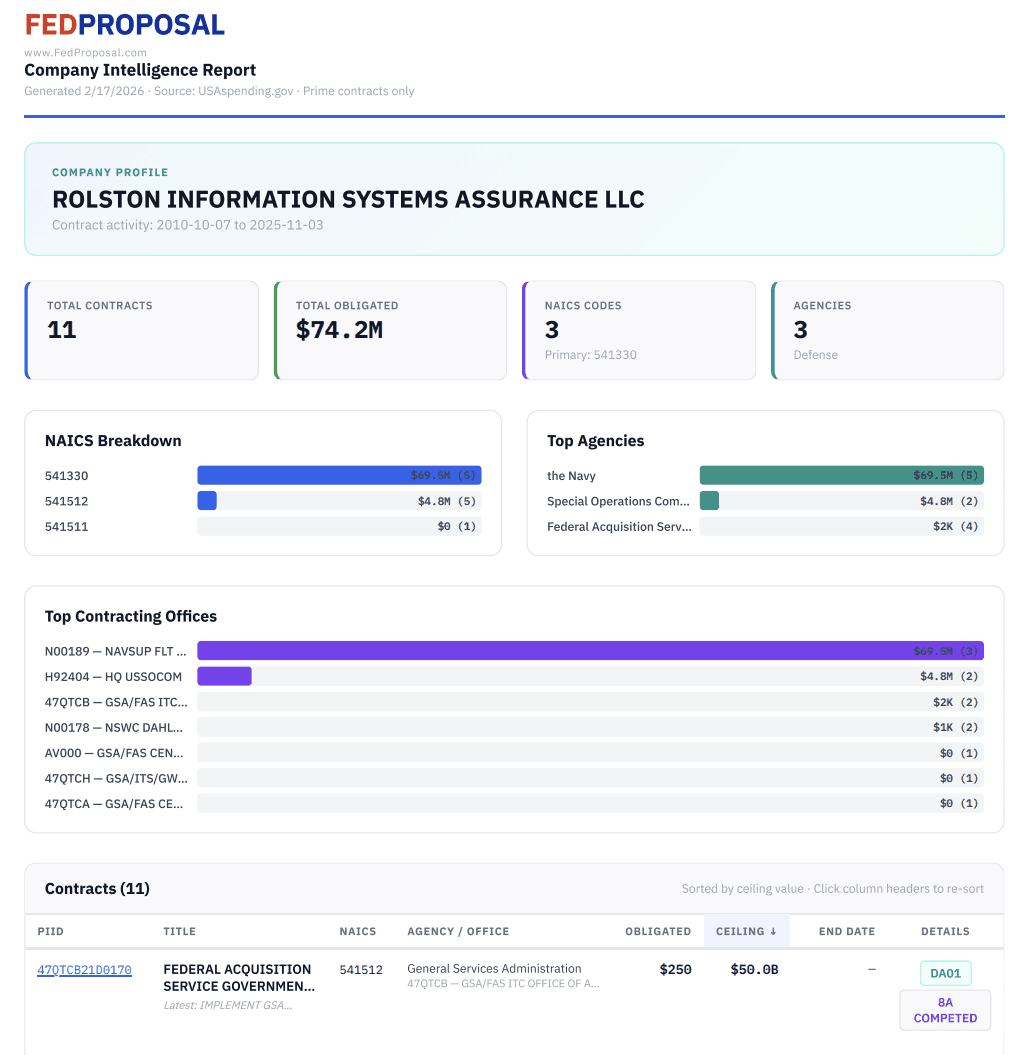
How FedProposal helps: Our expiring contracts dashboard lets you search thousands of federal contracts by agency, NAICS code, set-aside type, and end date. See who holds the contract now, how much they've been paid, and when it ends. Find recompete opportunities months before they hit SAM.gov—and start positioning while your competitors are still in the dark.
4. Contract Vehicles and IDIQs
Many federal opportunities never appear on SAM.gov at all. They're competed among holders of pre-awarded contract vehicles—IDIQs, GWACs, BPAs, and GSA Schedules.
If you're not on the vehicle, you can't compete for the task orders flowing through it.
Examples include:
GSA Multiple Award Schedule (MAS)
NIH CIO-SP4
Army ITES-3S
NASA SEWP
GSA OASIS and OASIS+
Getting on these vehicles requires an upfront proposal, but once you're awarded, you gain access to opportunities that non-holders simply can't pursue.
What to track: Monitor recompetes for major vehicles in your space. Most IDIQs and GWACs are re-competed every 5–10 years. Preparing early—sometimes years in advance—gives you a significant advantage.
5. Subcontracting and Teaming Opportunities
If you're not ready to prime contracts, subcontracting is a powerful entry point. You gain past performance, learn how agencies operate, and build relationships with primes who may bring you onto future bids.
Where to look:
SBA SubNet: A database of subcontracting opportunities posted by prime contractors
Prime contractor small business liaison offices: Large primes are required to meet small business subcontracting goals
Agency OSDBUs: Small business specialists can connect you with primes looking for partners
Teaming with the right prime can get you onto contracts you couldn't win alone—and build the past performance you need to eventually compete as a prime yourself.
How FedProposal helps: Our directory of 43 official agency small business portals gives you direct links to OSDBU offices across Defense and civilian agencies. These are the people who connect small businesses with primes and help you find teaming opportunities.
Going Beyond Databases: Relationship-Driven Opportunities
Databases tell you what's out there. Relationships tell you what's really happening.
Many of the best opportunities are shaped before they're ever posted. Requirements get written. Statements of work get drafted. Evaluation criteria get decided. If you're not in those conversations, you're responding to a solicitation that was written with someone else in mind.
Industry Days and Matchmaking Events
Agencies hold pre-solicitation events to present upcoming requirements and meet potential vendors. These are prime opportunities to:
Learn about upcoming procurements directly from program offices
Ask questions that help you understand agency priorities
Get face time with contracting officers and small business specialists
Meet primes looking for teaming partners
Even small "forecast update" webinars can give you intelligence that doesn't appear anywhere else.
Talking to Program Offices
Reaching out to contracting officers and program managers—before the RFP drops—helps you understand needs, challenges, and priorities. These conversations aren't about pitching. They're about listening.
The contractors who win consistently are the ones who show up early, ask smart questions, and demonstrate that they understand the mission.
APEX Accelerators (Formerly PTACs)
APEX Accelerators provide free counseling to businesses pursuing government contracts. They can help you:
Navigate registration and certification
Identify opportunities that match your capabilities
Prepare for proposals and compliance requirements
Connect with agency buyers and prime contractors
If you're new to federal contracting—or just want local, hands-on support—APEX Accelerators are an underutilized resource.
How FedProposal helps: We link directly to the APEX Accelerator network and curate their free training webinars covering capture, proposals, pricing, and certifications. We also offer on-demand recordings so you can learn on your schedule.
Filtering Opportunities to Match Your Business
Finding opportunities is only useful if you can filter them effectively. A firehose of irrelevant solicitations wastes as much time as no leads at all.
How to filter:
Use your NAICS codes: Search by the codes aligned to your primary services
Check for set-asides: If you're 8(a), SDVOSB, HUBZone, or WOSB, filter for opportunities reserved for your category
Focus on realistic contract sizes: Don't chase contracts far above your capacity or past performance
Prioritize agencies you know: It's easier to grow with existing customers than break into new ones
Look at expiring contracts: When a contract is ending, the recompete may be coming
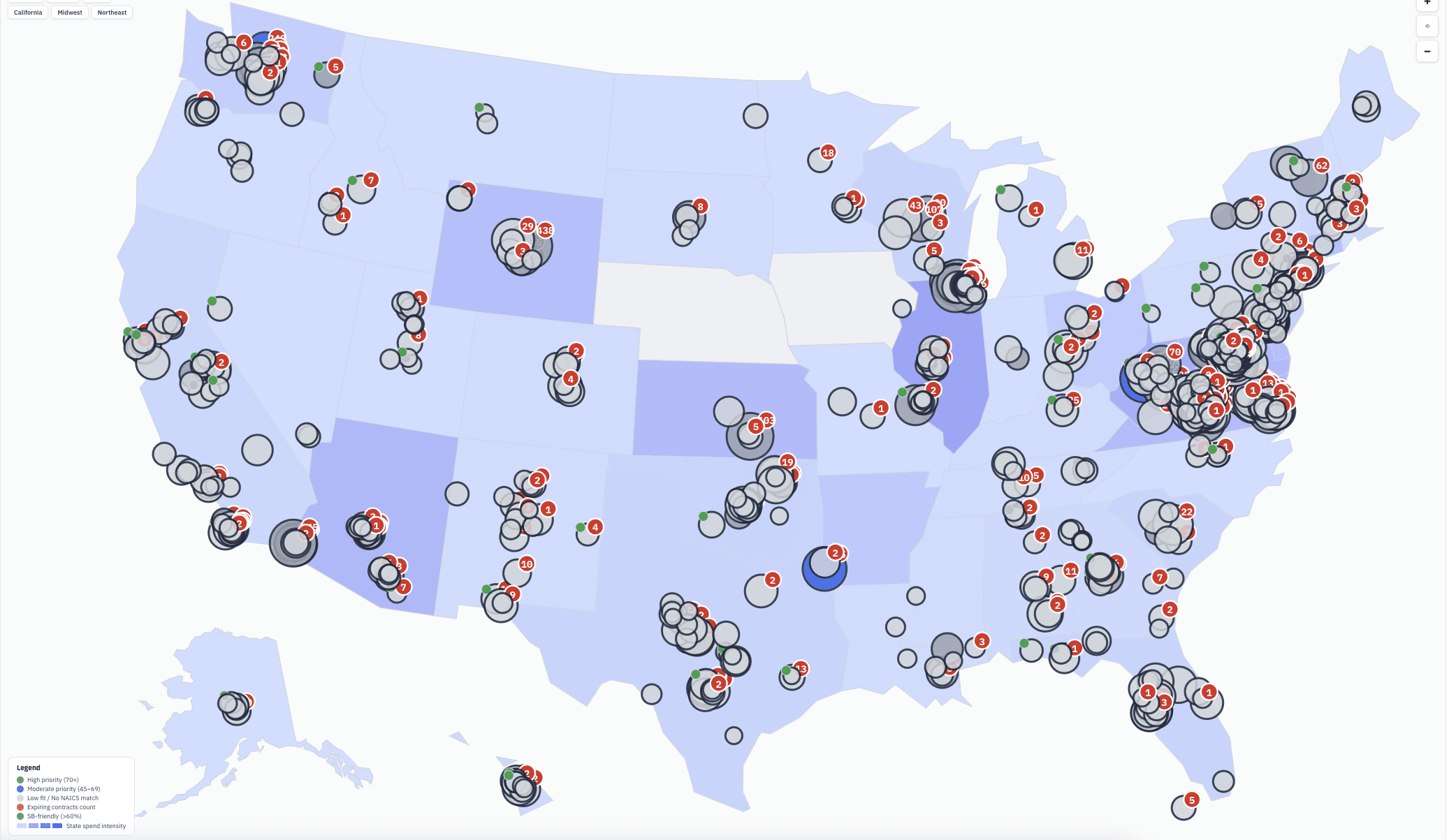
How FedProposal helps: Every search in FedProposal can be filtered by NAICS, set-aside type, agency, and contract value. Our AI-powered Fit Score goes further—it analyzes each opportunity against your company profile and tells you how well you match, so you focus on opportunities you can actually win.
Target Agencies That Need You
Here's a filter most contractors overlook: Which agencies are under pressure to award contracts to businesses like yours?
Every federal agency has small business contracting goals set by the SBA—targets for 8(a), SDVOSB, HUBZone, WOSB, and small business prime contracts overall. When an agency is falling short, they're actively looking for qualified small businesses to close the gap.
If you're a HUBZone contractor and an agency is behind on their HUBZone goal, that's an agency worth targeting. Your certification becomes a competitive advantage—not just a checkbox.
How FedProposal helps: Our agency small business performance dashboard shows how each agency is tracking against their SBA goals. Spot agencies hungry for your certification category and prioritize your outreach accordingly.
What Happened to That Contract You Were Watching?
Sometimes you track an opportunity but miss the recompete. The contract ended, a new one was awarded, and you weren't positioned in time. Knowing who won—and what they won—helps you prepare for the next cycle.
How FedProposal helps: Our successor contract search lets you find follow-on awards by place of performance, date range, NAICS code, and value. See who won when a contract you were tracking got recompeted, and use that intelligence to position for next time.
A Step-by-Step Strategy for Building a Pipeline
Set up daily SAM alerts for your NAICS codes—get real details, not vague notifications
Search agency forecasts quarterly to identify opportunities 6–18 months out
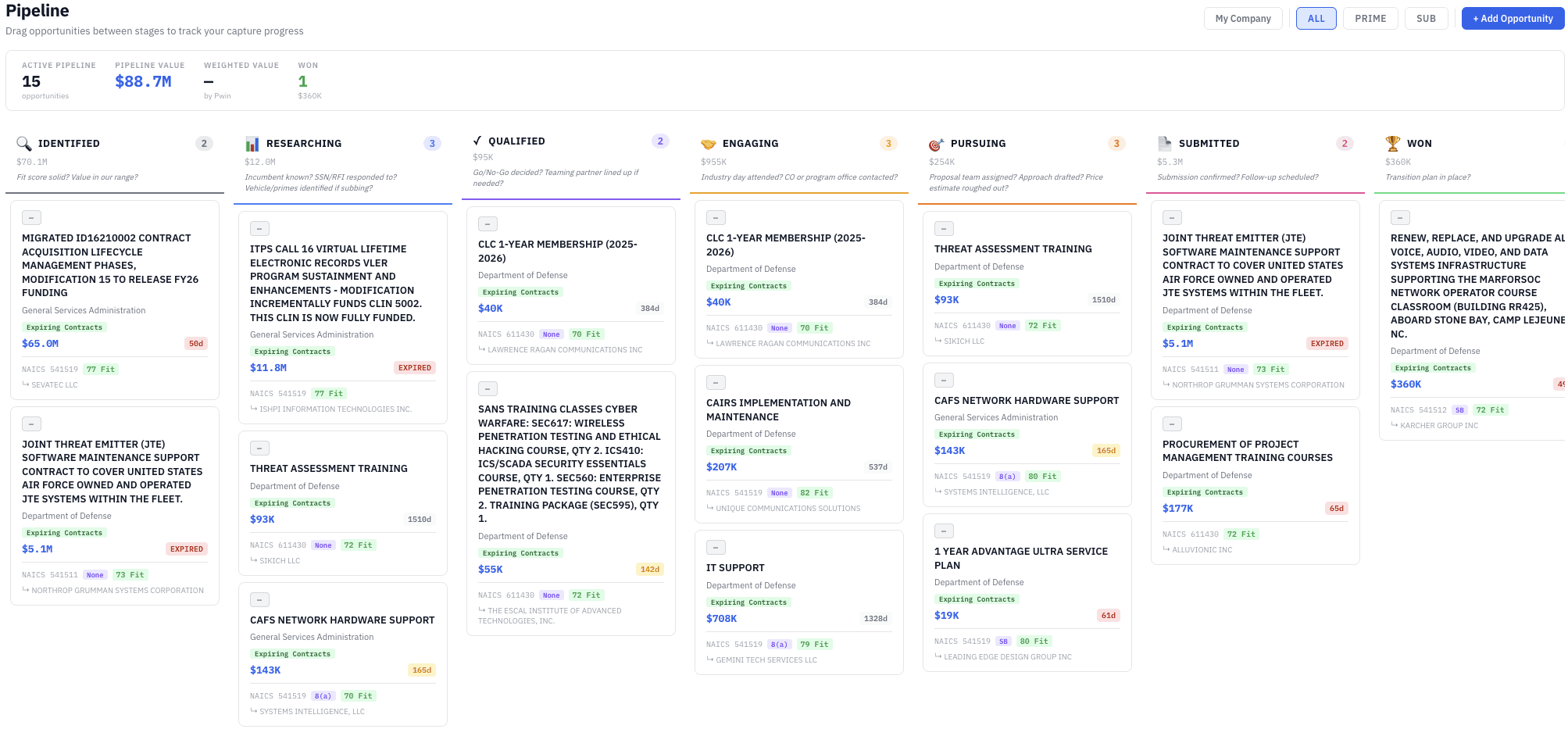
Monitor expiring contracts in your space to find recompetes before they're posted
Check your Fit Score to prioritize opportunities that match your profile
Review agency SB performance to target agencies that need your certifications
Identify OSDBU contacts and attend industry days for your target agencies
Explore subcontracting with primes to build past performance
Track successor contracts to learn from recompetes you missed
Export your pipeline to your CRM or BD tracking system
Common Mistakes to Avoid
Relying only on SAM.gov: By the time an RFP is posted, you're already behind
Chasing everything: Spreading yourself thin wastes resources and kills your win rate
Ignoring subcontracting: Teaming builds past performance and relationships
Failing to engage early: Waiting until a solicitation drops puts you in reaction mode
Not filtering for fit: Pursuing opportunities that don't match your profile is expensive
Conclusion: Build a Pipeline, Not a Prayer
Finding government contracting opportunities isn't about checking SAM.gov every morning. It's about building a pipeline that combines forecasts, expiring contracts, daily alerts, and relationships—so you're positioning early, not reacting late.
FedProposal brings it all together: daily SAM alerts with real details, forecast search across 27 agencies, an expiring contracts dashboard to find recompetes 12–18 months out, Fit Scores to prioritize your pursuits, and agency small business performance data to target the agencies that need you.
Stop refreshing SAM.gov. Stop chasing every opportunity. Start building a pipeline based on intelligence.
Government contracting is a competitive market. Agencies post thousands of solicitations every year, but not all are worth pursuing—and the best opportunities often aren't on SAM.gov yet.
Contractors who waste time chasing the wrong opportunities burn resources without winning work. Contractors who only monitor SAM.gov are always reacting, never positioning. The key is knowing where opportunities live, when to look, and which ones actually fit your business.
This guide covers all the places federal opportunities exist—from SAM.gov to agency forecasts to expiring contract databases—and how FedProposal brings them together so you can build a real pipeline.
The Primary Sources of Federal Opportunities
1. SAM.gov (System for Award Management)
SAM.gov is the official government-wide database for contract opportunities. Every solicitation over $25,000 must be posted here. You can search by NAICS code, keywords, place of performance, and agency.
For most contractors, SAM.gov is the starting point. But it has problems.
The SAM.gov frustration: You set up a saved search, and you get email alerts. Sounds great—until you see what those alerts actually look like:
"Dear Contractor, Your saved search has new updates. Click here to view updated records."
That's it. No opportunity title. No agency. No synopsis. Just a link that forces you to log in, re-run your search, and figure out what changed. It might be a perfect fit. It might be irrelevant. You won't know until you've spent 15 minutes digging.
Multiply that by a few saved searches, and you're burning hours every week just triaging alerts.
How FedProposal helps: Our daily SAM.gov alerts deliver new opportunities matching your NAICS codes straight to your inbox every night at 10 PM. You'll see actual details—title, agency, synopsis, notice type—without logging into anything. Monitor up to 3 NAICS codes and filter by notice type (Sources Sought, Pre-Solicitation, Solicitation) so you only see what matters.
No more vague emails. No more wasted time.
2. Agency Procurement Forecasts
Most agencies publish annual or multi-year procurement forecasts showing what they plan to buy. These forecasts give you visibility into opportunities months before they hit SAM.gov.
Why forecasts matter:
Time to position: You can start building relationships and shaping requirements while competitors wait for the RFP
Pipeline planning: See what's coming in the next 6–18 months and plan your BD resources accordingly
Early intelligence: Forecasts often include projected solicitation dates, contract vehicles, and estimated values
The problem? Forecasts are scattered across dozens of agency websites. Some are easy to find. Others are buried in procurement portals. Checking them all manually every quarter isn't realistic for most small teams.
How FedProposal helps: Our forecast search pulls planned acquisitions from 27 federal agencies into one searchable dashboard. Filter by NAICS code, fiscal year, agency, or keyword. No more bookmarking agency pages and hoping you remember to check them.
3. Expiring Contracts
Here's where smart contractors gain a real edge.
Every federal contract has an end date. When that contract expires, the agency usually still needs the work done—which means a recompete is coming. If you can identify expiring contracts in your space 12–18 months before they end, you can start positioning long before anyone else knows an opportunity exists.
This is how incumbents stay incumbents. They know the contract timeline. They know when the recompete is coming. They're already talking to the program office while competitors are waiting for a SAM.gov alert that won't come for another year.
Finding expiring contracts manually means searching FPDS, filtering by end date, cross-referencing NAICS codes, and building your own tracking spreadsheet. It's powerful intelligence—but it's tedious work.
How FedProposal helps: Our expiring contracts dashboard lets you search thousands of federal contracts by agency, NAICS code, set-aside type, and end date. See who holds the contract now, how much they've been paid, and when it ends. Find recompete opportunities months before they hit SAM.gov—and start positioning while your competitors are still in the dark.
4. Contract Vehicles and IDIQs
Many federal opportunities never appear on SAM.gov at all. They're competed among holders of pre-awarded contract vehicles—IDIQs, GWACs, BPAs, and GSA Schedules.
If you're not on the vehicle, you can't compete for the task orders flowing through it.
Examples include:
GSA Multiple Award Schedule (MAS)
NIH CIO-SP4
Army ITES-3S
NASA SEWP
GSA OASIS and OASIS+
Getting on these vehicles requires an upfront proposal, but once you're awarded, you gain access to opportunities that non-holders simply can't pursue.
What to track: Monitor recompetes for major vehicles in your space. Most IDIQs and GWACs are re-competed every 5–10 years. Preparing early—sometimes years in advance—gives you a significant advantage.
5. Subcontracting and Teaming Opportunities
If you're not ready to prime contracts, subcontracting is a powerful entry point. You gain past performance, learn how agencies operate, and build relationships with primes who may bring you onto future bids.
Where to look:
SBA SubNet: A database of subcontracting opportunities posted by prime contractors
Prime contractor small business liaison offices: Large primes are required to meet small business subcontracting goals
Agency OSDBUs: Small business specialists can connect you with primes looking for partners
Teaming with the right prime can get you onto contracts you couldn't win alone—and build the past performance you need to eventually compete as a prime yourself.
How FedProposal helps: Our directory of 43 official agency small business portals gives you direct links to OSDBU offices across Defense and civilian agencies. These are the people who connect small businesses with primes and help you find teaming opportunities.
Going Beyond Databases: Relationship-Driven Opportunities
Databases tell you what's out there. Relationships tell you what's really happening.
Many of the best opportunities are shaped before they're ever posted. Requirements get written. Statements of work get drafted. Evaluation criteria get decided. If you're not in those conversations, you're responding to a solicitation that was written with someone else in mind.
Industry Days and Matchmaking Events
Agencies hold pre-solicitation events to present upcoming requirements and meet potential vendors. These are prime opportunities to:
Learn about upcoming procurements directly from program offices
Ask questions that help you understand agency priorities
Get face time with contracting officers and small business specialists
Meet primes looking for teaming partners
Even small "forecast update" webinars can give you intelligence that doesn't appear anywhere else.
Talking to Program Offices
Reaching out to contracting officers and program managers—before the RFP drops—helps you understand needs, challenges, and priorities. These conversations aren't about pitching. They're about listening.
The contractors who win consistently are the ones who show up early, ask smart questions, and demonstrate that they understand the mission.
APEX Accelerators (Formerly PTACs)
APEX Accelerators provide free counseling to businesses pursuing government contracts. They can help you:
Navigate registration and certification
Identify opportunities that match your capabilities
Prepare for proposals and compliance requirements
Connect with agency buyers and prime contractors
If you're new to federal contracting—or just want local, hands-on support—APEX Accelerators are an underutilized resource.
How FedProposal helps: We link directly to the APEX Accelerator network and curate their free training webinars covering capture, proposals, pricing, and certifications. We also offer on-demand recordings so you can learn on your schedule.
Filtering Opportunities to Match Your Business
Finding opportunities is only useful if you can filter them effectively. A firehose of irrelevant solicitations wastes as much time as no leads at all.
How to filter:
Use your NAICS codes: Search by the codes aligned to your primary services
Check for set-asides: If you're 8(a), SDVOSB, HUBZone, or WOSB, filter for opportunities reserved for your category
Focus on realistic contract sizes: Don't chase contracts far above your capacity or past performance
Prioritize agencies you know: It's easier to grow with existing customers than break into new ones
Look at expiring contracts: When a contract is ending, the recompete may be coming
How FedProposal helps: Every search in FedProposal can be filtered by NAICS, set-aside type, agency, and contract value. Our AI-powered Fit Score goes further—it analyzes each opportunity against your company profile and tells you how well you match, so you focus on opportunities you can actually win.
Target Agencies That Need You
Here's a filter most contractors overlook: Which agencies are under pressure to award contracts to businesses like yours?
Every federal agency has small business contracting goals set by the SBA—targets for 8(a), SDVOSB, HUBZone, WOSB, and small business prime contracts overall. When an agency is falling short, they're actively looking for qualified small businesses to close the gap.
If you're a HUBZone contractor and an agency is behind on their HUBZone goal, that's an agency worth targeting. Your certification becomes a competitive advantage—not just a checkbox.
How FedProposal helps: Our agency small business performance dashboard shows how each agency is tracking against their SBA goals. Spot agencies hungry for your certification category and prioritize your outreach accordingly.
What Happened to That Contract You Were Watching?
Sometimes you track an opportunity but miss the recompete. The contract ended, a new one was awarded, and you weren't positioned in time. Knowing who won—and what they won—helps you prepare for the next cycle.
How FedProposal helps: Our successor contract search lets you find follow-on awards by place of performance, date range, NAICS code, and value. See who won when a contract you were tracking got recompeted, and use that intelligence to position for next time.
A Step-by-Step Strategy for Building a Pipeline
Set up daily SAM alerts for your NAICS codes—get real details, not vague notifications
Search agency forecasts quarterly to identify opportunities 6–18 months out
Monitor expiring contracts in your space to find recompetes before they're posted
Check your Fit Score to prioritize opportunities that match your profile
Review agency SB performance to target agencies that need your certifications
Identify OSDBU contacts and attend industry days for your target agencies
Explore subcontracting with primes to build past performance
Track successor contracts to learn from recompetes you missed
Export your pipeline to your CRM or BD tracking system
Common Mistakes to Avoid
Relying only on SAM.gov: By the time an RFP is posted, you're already behind
Chasing everything: Spreading yourself thin wastes resources and kills your win rate
Ignoring subcontracting: Teaming builds past performance and relationships
Failing to engage early: Waiting until a solicitation drops puts you in reaction mode
Not filtering for fit: Pursuing opportunities that don't match your profile is expensive
Conclusion: Build a Pipeline, Not a Prayer
Finding government contracting opportunities isn't about checking SAM.gov every morning. It's about building a pipeline that combines forecasts, expiring contracts, daily alerts, and relationships—so you're positioning early, not reacting late.
FedProposal brings it all together: daily SAM alerts with real details, forecast search across 27 agencies, an expiring contracts dashboard to find recompetes 12–18 months out, Fit Scores to prioritize your pursuits, and agency small business performance data to target the agencies that need you.
Stop refreshing SAM.gov. Stop chasing every opportunity. Start building a pipeline based on intelligence.