Technical
IDIQs, GWACs, and BPAs Explained — How Contract Vehicles Actually Work
If you've spent any time in federal contracting, you've heard the alphabet soup: IDIQ, GWAC, BPA, GSA Schedule, OASIS, SEWP, Alliant. These aren't just acronyms—they're the highways that federal spending travels on. And if you're not on the right highway, you can't compete for the work flowing through it.
Contract vehicles confuse a lot of new contractors. They assume that every federal opportunity gets posted on SAM.gov and anyone can bid. The reality is different. Many of the best opportunities—especially in IT and professional services—are competed only among vendors who already hold a spot on a specific vehicle. If you're not on it, you're locked out.
Understanding how vehicles work changes how you think about business development. It's not just about finding opportunities. It's about getting on the vehicles where opportunities flow—and then marketing yourself to the agencies using them.
In this post, we'll break down the three main types of contract vehicles: IDIQs, GWACs, and BPAs. We'll explain how they work, why agencies use them, and how to decide which ones are worth pursuing. We'll also show you how FedProposal can help you track vehicle activity, monitor expiring contracts tied to major vehicles, and identify where the work is actually going.
The vehicle is the door. Let's get you through it.
If you've spent any time in federal contracting, you've heard the alphabet soup: IDIQ, GWAC, BPA, GSA Schedule, OASIS, SEWP, Alliant. These aren't just acronyms—they're the highways that federal spending travels on. And if you're not on the right highway, you can't compete for the work flowing through it.
Contract vehicles confuse a lot of new contractors. They assume that every federal opportunity gets posted on SAM.gov and anyone can bid. The reality is different. Many of the best opportunities—especially in IT and professional services—are competed only among vendors who already hold a spot on a specific vehicle. If you're not on it, you're locked out.
Understanding how vehicles work changes how you think about business development. It's not just about finding opportunities. It's about getting on the vehicles where opportunities flow—and then marketing yourself to the agencies using them.
In this post, we'll break down the three main types of contract vehicles: IDIQs, GWACs, and BPAs. We'll explain how they work, why agencies use them, and how to decide which ones are worth pursuing. We'll also show you how FedProposal can help you track vehicle activity, monitor expiring contracts tied to major vehicles, and identify where the work is actually going.
The vehicle is the door. Let's get you through it.


When federal contracting professionals talk about "contract vehicles," they're referring to pre-established agreements that agencies use to buy goods and services. Think of them as on-ramps to federal spending. Once you're on the vehicle, you can compete for orders. Until then, you're standing outside looking in.
Understanding IDIQs, GWACs, and BPAs is essential because these vehicles dominate federal procurement—especially in IT and professional services. Winning a seat doesn't guarantee revenue, but it guarantees access to opportunities that non-holders simply can't pursue.
What Are Contract Vehicles?
A contract vehicle is not the purchase itself. It's a framework agreement that establishes terms, conditions, and pricing for future purchases. Agencies use vehicles to save time, reduce duplication, and streamline procurement.
For contractors, the key takeaway is this: the vehicle is the door. Without the right door, you can't walk into the room where the competition is happening.
When an agency needs IT support, they often don't post a new solicitation on SAM.gov. Instead, they issue a task order to the vendors holding their preferred IDIQ or GWAC. If you're not on that vehicle, you never see the opportunity.
This is why business development in federal contracting isn't just about finding opportunities. It's about getting on the vehicles where opportunities flow.
Indefinite Delivery, Indefinite Quantity (IDIQ) Contracts
What Is an IDIQ?
IDIQ contracts are one of the most widely used mechanisms in federal procurement. As the name suggests, they allow agencies to order an indefinite quantity of supplies or services over a fixed period. The contract establishes the ceiling value, ordering procedures, and terms—but the exact volume and timing of orders isn't known upfront.
Why Agencies Use IDIQs
Agencies like IDIQs because they provide flexibility. Instead of running a full-and-open competition for every project, the agency competes task orders among pre-qualified IDIQ holders. This streamlines procurement while maintaining competition.
For a program manager who needs support fast, going to an existing IDIQ is far easier than starting a new procurement from scratch.
How IDIQs Work
The government awards a base IDIQ contract to multiple vendors (sometimes dozens)
Vendors are then eligible to compete for task orders (services) or delivery orders (supplies)
Each order is competed among the IDIQ holders, unless it's a sole-source or directed award
The contract runs for a base period plus option years—typically 5–10 years total
Examples of Major IDIQs
Army ITES-3S: IT enterprise solutions and services
Navy SeaPort-NxG: Engineering, logistics, and program management
GSA OASIS/OASIS+: Professional services across multiple disciplines
CMS SPARC: IT and health-related services for CMS
How FedProposal helps:
Our expiring contracts dashboard includes contracts awarded under major IDIQs. You can see which task orders are ending, who holds them, and what the government has paid—helping you identify upcoming recompetes within vehicles you hold (or want to hold).
Governmentwide Acquisition Contracts (GWACs)
What Is a GWAC?
GWACs are a special type of IDIQ available to all federal agencies, not just the one that awarded it. Managed primarily by GSA, NASA, and NIH, GWACs help agencies buy IT solutions efficiently without running their own procurements.
Why Agencies Use GWACs
GWACs reduce duplication across the government. Instead of every agency creating its own IT contract, they can all leverage the same pre-competed pool of vendors. This saves time, ensures compliance with cybersecurity and supply chain requirements, and gives agencies access to vetted contractors.
For agencies without strong procurement shops, GWACs are especially attractive—the hard work of vetting vendors is already done.
How GWACs Work
Vendors compete to win a spot on the GWAC (these competitions are highly competitive)
Once awarded, agencies across the entire federal government can place orders with GWAC holders
Most GWACs have small business tracks or set-aside pools (8(a), HUBZone, SDVOSB, WOSB)
Contract periods typically run 5–10 years
Examples of Major GWACs
GSA Alliant 2 / Alliant 3: Large-scale IT solutions
NIH CIO-SP4: IT services for health and civilian agencies
NASA SEWP V / SEWP VI: IT hardware and services
8(a) STARS III: IT services reserved for 8(a) contractors
The GWAC Advantage for Small Businesses
Many GWACs have dedicated small business tracks. If you're an 8(a) contractor on 8(a) STARS III, you're competing against other 8(a) firms—not large primes. These vehicles can be transformative for small businesses that get on them.
How FedProposal helps:
Track which agencies are actively using specific GWACs by monitoring task order awards in our expiring contracts dashboard. If you hold a GWAC, understanding where the orders are flowing helps you focus your marketing on the right buyers.
Blanket Purchase Agreements (BPAs)
What Is a BPA?
A BPA is a simplified acquisition method that establishes a "charge account" with selected vendors. Unlike IDIQs—which often span multiple agencies and involve complex competitions—BPAs are usually set up by a specific office or agency for recurring purchases.
Why Agencies Use BPAs
BPAs streamline the acquisition of routine, repetitive needs. They reduce paperwork by establishing pre-negotiated terms for common buys. Instead of creating a new contract every time an office needs training services or IT support, the agency just issues a "call" under the BPA.
BPAs are often used for:
Office supplies and equipment
IT help desk support
Training services
Staff augmentation
Recurring maintenance
How BPAs Work
An agency negotiates BPAs with one or more vendors
The agreement defines pricing, delivery terms, and scope
When the agency needs something, they issue a call or order under the BPA
No new solicitation required—just a simple order against established terms
BPAs vs. IDIQs
BPAs are generally smaller in scope and easier to win than IDIQs. They're often a good entry point for small businesses looking to establish relationships with specific offices before pursuing larger vehicles.
How FedProposal helps:
BPA opportunities often appear in SAM.gov as sources sought or solicitations before they're established. Our daily SAM alerts can help you catch these opportunities early—before the BPA is awarded and the door closes.
Common Misconceptions
"Winning a vehicle means winning revenue."
False. Winning a seat is only the beginning. You still need to compete for task orders, market yourself to ordering agencies, and deliver successfully. Many contractors win vehicle spots and never see significant revenue because they don't actively pursue the work flowing through them.
"Vehicles are only for large businesses."
Not true. Many IDIQs, GWACs, and BPAs have small business tracks or set-asides. Vehicles like 8(a) STARS III are exclusively for small businesses. The key is knowing which vehicles align with your certifications and capabilities.
"If I'm not on a vehicle, I can't participate."
Incorrect. Subcontracting under these vehicles is common and often a smart entry strategy. Large primes holding vehicle spots need capable subcontractors—especially small businesses that help them meet subcontracting goals. Subcontracting builds past performance and relationships that can help you win your own vehicle spot later.
Strategies for Success with Contract Vehicles
1. Choose Vehicles Strategically
Not every vehicle is right for your company. Before investing hundreds of hours in a vehicle proposal, research:
What types of task orders flow through this vehicle?
Which agencies use it most heavily?
What's the average task order size?
Does your past performance align with the work?
Are there small business tracks that match your certifications?
A vehicle that looks prestigious on paper may generate little revenue if the work doesn't match your capabilities.
How FedProposal helps:
Use our expiring contracts dashboard to research task orders awarded under specific vehicles. See who's winning, what they're being paid, and which agencies are buying. This intelligence helps you decide whether a vehicle is worth pursuing.
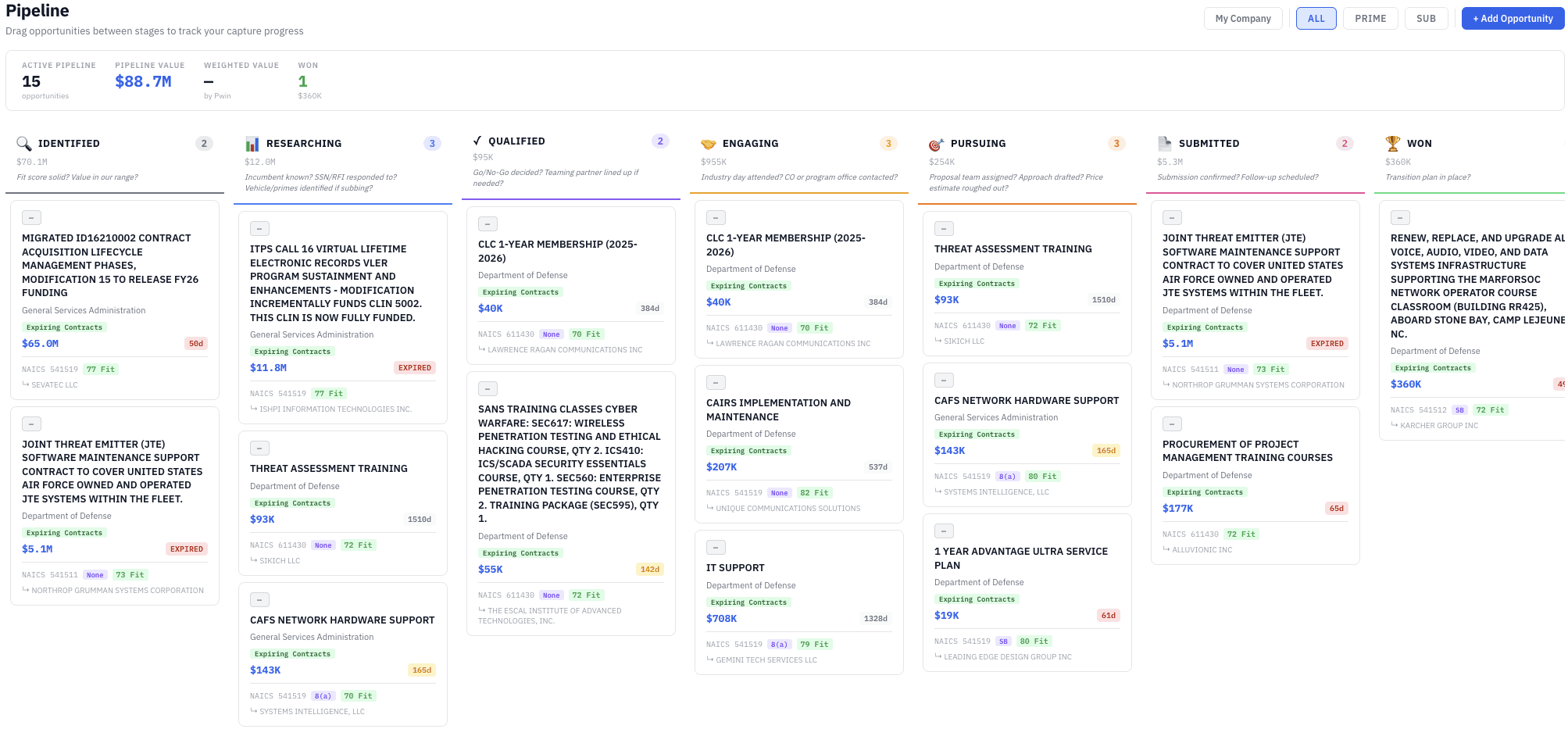
2. Build a Vehicle Pipeline
Most vehicles are recompeted every 5–10 years. The contractors who win aren't the ones who start preparing when the solicitation drops—they're the ones who've been tracking the recompete for years.
Key vehicle recompetes to watch:
When is the current vehicle ending?
Has the agency announced a follow-on?
What lessons learned can you gather from the current vehicle?
Who are the likely competitors?
Starting early—sometimes 2–3 years before the recompete—gives you time to build past performance, pursue relevant subcontracts, and position your company.
How FedProposal helps:
Our expiring contracts dashboard shows contract end dates, including for major vehicle task orders. Track when vehicles and their task orders are ending to anticipate recompete timelines.
3. Subcontract First
If you're not ready to win a prime vehicle spot, subcontracting is a powerful alternative. Benefits include:
Gain past performance on the vehicle's work
Build relationships with primes who may partner with you later
Learn how the vehicle operates from the inside
Generate revenue while you prepare for your own bid
Many small businesses have won prime vehicle spots after years of successful subcontracting on the same vehicle.
4. Market Aggressively After You Win
Winning a vehicle spot is not the finish line—it's the starting line. The real work begins after award:
Identify the contracting officers and program managers who use your vehicle
Attend industry days and agency events
Send targeted capability statements to ordering offices
Track task order forecasts and upcoming requirements
Build relationships before task orders are released
Simply holding a contract vehicle doesn't generate business. Visibility and relationships do.
How FedProposal helps:
Our agency small business portal directory gives you direct access to 43 OSDBU offices across Defense and civilian agencies. These contacts can help you understand which offices use your vehicle and connect you with program managers.
5. Track Task Order Activity
Understanding who's buying what—and how much—is crucial for targeting your outreach. If Agency X has awarded $50 million in task orders through your GWAC this year, that's an agency worth pursuing. If Agency Y has used it once, maybe focus elsewhere.
How FedProposal helps:
Our expiring contracts dashboard and successor contract search let you track task order activity by agency, NAICS, and value. See where the money is flowing through your vehicle—and focus your marketing accordingly.
Know Which Vehicle You're Up Against
Here's a challenge most contractors face: you find an expiring contract that looks promising, but you don't know which vehicle it's on. Is it SeaPort-NxG? OASIS+? CIO-SP4? A direct agency IDIQ? Without this information, you can't determine whether you can compete—or whether you need to find a teaming partner who holds the vehicle.
Most contractors spend hours researching this manually, digging through contract records and PIID patterns to figure out the procurement path.
How FedProposal helps:
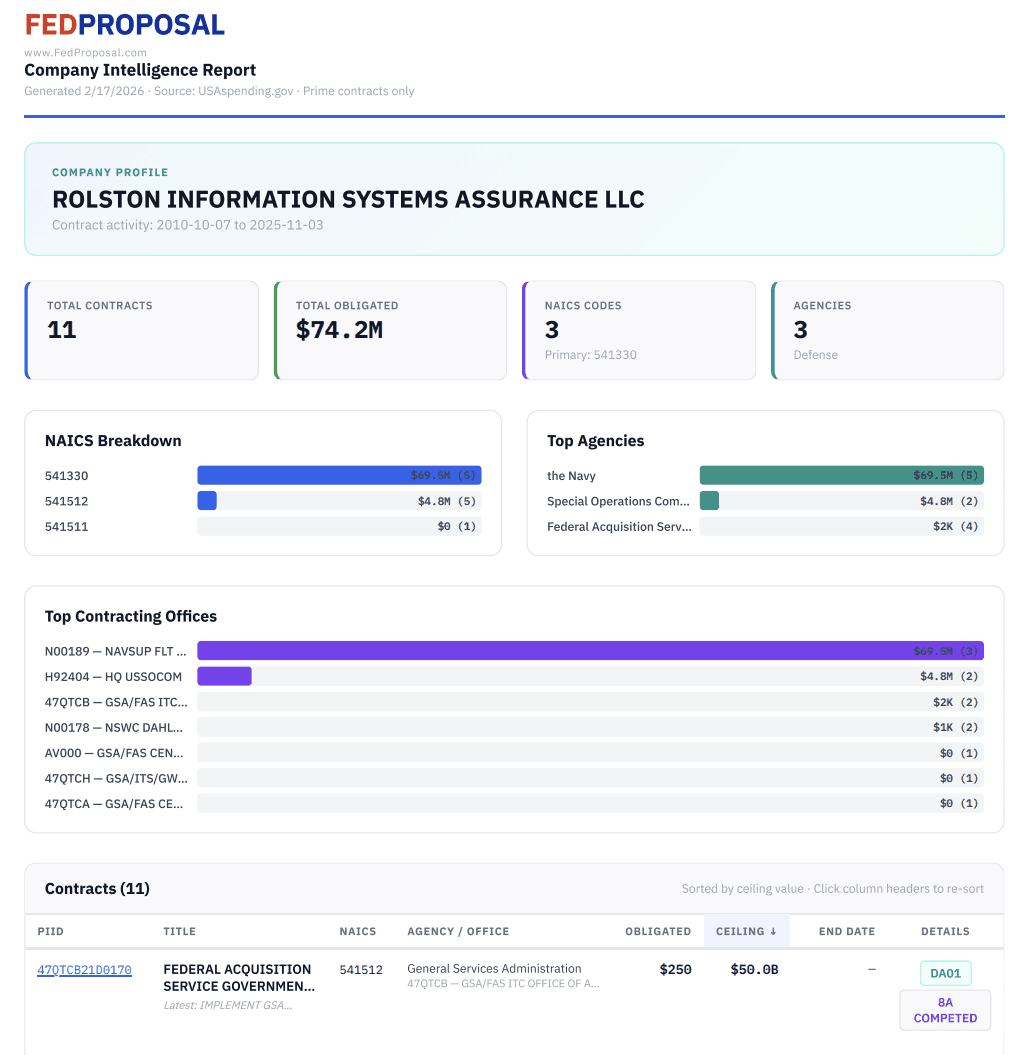
We automatically identify and display contract vehicle information for every contract in our database. When you're researching an expiring contract, you'll instantly see which vehicle was used—giving you critical intelligence for your capture strategy.
Our contract vehicle detection covers 60+ unique vehicles across:
GSA Governmentwide: OASIS+, Alliant 2, 8(a) STARS III, Polaris, VETS 2, HCaTS, EIS, and more
NASA & NIH: SEWP V, SEWP VI, CIO-SP4, CIO-SP3, CIO-CS
Army: ITES-3S, ITES-3H, RS3, CHESS, AMCOM EXPRESS
Navy: SeaPort-NxG, NAVAIR, NAVSEA, NAVWAR
Air Force: NETCENTS-2, SBEAS, TSA IV, AFRL
DISA: ENCORE III, SETI, GSM-O II
DHS: EAGLE II, PACTS III, ICE, CBP
VA: T4NG, T4NG2, VA IT IDIQ
Other DoD & Civilian: IAC MAC, SITE III, SOCOM, DOE, DOJ, State, HHS, and many more
Understanding which vehicle was used for an expiring contract tells you:
Whether you need to be on a specific vehicle to compete for the recompete
The likely procurement path the agency will take
Competition level (some vehicles have limited pool holders)
Your teaming strategy (partner with a vehicle holder if you're not on it)
For a complete list of all 60+ contract vehicles we track, visit fedproposal.com/contract-vehicles-tracked.
Conclusion: The Vehicle Is the Door
Contract vehicles are central to how the federal government buys. IDIQs, GWACs, and BPAs each serve different purposes, but they share one trait: they create exclusive pools of vendors eligible for orders. If you're not in the pool, you're not competing.
For contractors, the challenge isn't just getting on a vehicle—it's positioning yourself to win meaningful work once you're on it.
A smart vehicle strategy includes:
Researching which vehicles align with your capabilities and certifications
Tracking task order activity to understand where the work flows
Building past performance through subcontracting
Preparing for recompetes years in advance
Marketing aggressively to ordering agencies after you win
FedProposal helps you track the work flowing through vehicles: expiring task orders, agency buying patterns, incumbent data, contract vehicle identification, and upcoming recompetes. Because getting on the vehicle is just the beginning. Winning the work that flows through it—that's where success lives in federal contracting.
When federal contracting professionals talk about "contract vehicles," they're referring to pre-established agreements that agencies use to buy goods and services. Think of them as on-ramps to federal spending. Once you're on the vehicle, you can compete for orders. Until then, you're standing outside looking in.
Understanding IDIQs, GWACs, and BPAs is essential because these vehicles dominate federal procurement—especially in IT and professional services. Winning a seat doesn't guarantee revenue, but it guarantees access to opportunities that non-holders simply can't pursue.
What Are Contract Vehicles?
A contract vehicle is not the purchase itself. It's a framework agreement that establishes terms, conditions, and pricing for future purchases. Agencies use vehicles to save time, reduce duplication, and streamline procurement.
For contractors, the key takeaway is this: the vehicle is the door. Without the right door, you can't walk into the room where the competition is happening.
When an agency needs IT support, they often don't post a new solicitation on SAM.gov. Instead, they issue a task order to the vendors holding their preferred IDIQ or GWAC. If you're not on that vehicle, you never see the opportunity.
This is why business development in federal contracting isn't just about finding opportunities. It's about getting on the vehicles where opportunities flow.
Indefinite Delivery, Indefinite Quantity (IDIQ) Contracts
What Is an IDIQ?
IDIQ contracts are one of the most widely used mechanisms in federal procurement. As the name suggests, they allow agencies to order an indefinite quantity of supplies or services over a fixed period. The contract establishes the ceiling value, ordering procedures, and terms—but the exact volume and timing of orders isn't known upfront.
Why Agencies Use IDIQs
Agencies like IDIQs because they provide flexibility. Instead of running a full-and-open competition for every project, the agency competes task orders among pre-qualified IDIQ holders. This streamlines procurement while maintaining competition.
For a program manager who needs support fast, going to an existing IDIQ is far easier than starting a new procurement from scratch.
How IDIQs Work
The government awards a base IDIQ contract to multiple vendors (sometimes dozens)
Vendors are then eligible to compete for task orders (services) or delivery orders (supplies)
Each order is competed among the IDIQ holders, unless it's a sole-source or directed award
The contract runs for a base period plus option years—typically 5–10 years total
Examples of Major IDIQs
Army ITES-3S: IT enterprise solutions and services
Navy SeaPort-NxG: Engineering, logistics, and program management
GSA OASIS/OASIS+: Professional services across multiple disciplines
CMS SPARC: IT and health-related services for CMS
How FedProposal helps:
Our expiring contracts dashboard includes contracts awarded under major IDIQs. You can see which task orders are ending, who holds them, and what the government has paid—helping you identify upcoming recompetes within vehicles you hold (or want to hold).
Governmentwide Acquisition Contracts (GWACs)
What Is a GWAC?
GWACs are a special type of IDIQ available to all federal agencies, not just the one that awarded it. Managed primarily by GSA, NASA, and NIH, GWACs help agencies buy IT solutions efficiently without running their own procurements.
Why Agencies Use GWACs
GWACs reduce duplication across the government. Instead of every agency creating its own IT contract, they can all leverage the same pre-competed pool of vendors. This saves time, ensures compliance with cybersecurity and supply chain requirements, and gives agencies access to vetted contractors.
For agencies without strong procurement shops, GWACs are especially attractive—the hard work of vetting vendors is already done.
How GWACs Work
Vendors compete to win a spot on the GWAC (these competitions are highly competitive)
Once awarded, agencies across the entire federal government can place orders with GWAC holders
Most GWACs have small business tracks or set-aside pools (8(a), HUBZone, SDVOSB, WOSB)
Contract periods typically run 5–10 years
Examples of Major GWACs
GSA Alliant 2 / Alliant 3: Large-scale IT solutions
NIH CIO-SP4: IT services for health and civilian agencies
NASA SEWP V / SEWP VI: IT hardware and services
8(a) STARS III: IT services reserved for 8(a) contractors
The GWAC Advantage for Small Businesses
Many GWACs have dedicated small business tracks. If you're an 8(a) contractor on 8(a) STARS III, you're competing against other 8(a) firms—not large primes. These vehicles can be transformative for small businesses that get on them.
How FedProposal helps:
Track which agencies are actively using specific GWACs by monitoring task order awards in our expiring contracts dashboard. If you hold a GWAC, understanding where the orders are flowing helps you focus your marketing on the right buyers.
Blanket Purchase Agreements (BPAs)
What Is a BPA?
A BPA is a simplified acquisition method that establishes a "charge account" with selected vendors. Unlike IDIQs—which often span multiple agencies and involve complex competitions—BPAs are usually set up by a specific office or agency for recurring purchases.
Why Agencies Use BPAs
BPAs streamline the acquisition of routine, repetitive needs. They reduce paperwork by establishing pre-negotiated terms for common buys. Instead of creating a new contract every time an office needs training services or IT support, the agency just issues a "call" under the BPA.
BPAs are often used for:
Office supplies and equipment
IT help desk support
Training services
Staff augmentation
Recurring maintenance
How BPAs Work
An agency negotiates BPAs with one or more vendors
The agreement defines pricing, delivery terms, and scope
When the agency needs something, they issue a call or order under the BPA
No new solicitation required—just a simple order against established terms
BPAs vs. IDIQs
BPAs are generally smaller in scope and easier to win than IDIQs. They're often a good entry point for small businesses looking to establish relationships with specific offices before pursuing larger vehicles.
How FedProposal helps:
BPA opportunities often appear in SAM.gov as sources sought or solicitations before they're established. Our daily SAM alerts can help you catch these opportunities early—before the BPA is awarded and the door closes.
Common Misconceptions
"Winning a vehicle means winning revenue."
False. Winning a seat is only the beginning. You still need to compete for task orders, market yourself to ordering agencies, and deliver successfully. Many contractors win vehicle spots and never see significant revenue because they don't actively pursue the work flowing through them.
"Vehicles are only for large businesses."
Not true. Many IDIQs, GWACs, and BPAs have small business tracks or set-asides. Vehicles like 8(a) STARS III are exclusively for small businesses. The key is knowing which vehicles align with your certifications and capabilities.
"If I'm not on a vehicle, I can't participate."
Incorrect. Subcontracting under these vehicles is common and often a smart entry strategy. Large primes holding vehicle spots need capable subcontractors—especially small businesses that help them meet subcontracting goals. Subcontracting builds past performance and relationships that can help you win your own vehicle spot later.
Strategies for Success with Contract Vehicles
1. Choose Vehicles Strategically
Not every vehicle is right for your company. Before investing hundreds of hours in a vehicle proposal, research:
What types of task orders flow through this vehicle?
Which agencies use it most heavily?
What's the average task order size?
Does your past performance align with the work?
Are there small business tracks that match your certifications?
A vehicle that looks prestigious on paper may generate little revenue if the work doesn't match your capabilities.
How FedProposal helps:
Use our expiring contracts dashboard to research task orders awarded under specific vehicles. See who's winning, what they're being paid, and which agencies are buying. This intelligence helps you decide whether a vehicle is worth pursuing.
2. Build a Vehicle Pipeline
Most vehicles are recompeted every 5–10 years. The contractors who win aren't the ones who start preparing when the solicitation drops—they're the ones who've been tracking the recompete for years.
Key vehicle recompetes to watch:
When is the current vehicle ending?
Has the agency announced a follow-on?
What lessons learned can you gather from the current vehicle?
Who are the likely competitors?
Starting early—sometimes 2–3 years before the recompete—gives you time to build past performance, pursue relevant subcontracts, and position your company.
How FedProposal helps:
Our expiring contracts dashboard shows contract end dates, including for major vehicle task orders. Track when vehicles and their task orders are ending to anticipate recompete timelines.
3. Subcontract First
If you're not ready to win a prime vehicle spot, subcontracting is a powerful alternative. Benefits include:
Gain past performance on the vehicle's work
Build relationships with primes who may partner with you later
Learn how the vehicle operates from the inside
Generate revenue while you prepare for your own bid
Many small businesses have won prime vehicle spots after years of successful subcontracting on the same vehicle.
4. Market Aggressively After You Win
Winning a vehicle spot is not the finish line—it's the starting line. The real work begins after award:
Identify the contracting officers and program managers who use your vehicle
Attend industry days and agency events
Send targeted capability statements to ordering offices
Track task order forecasts and upcoming requirements
Build relationships before task orders are released
Simply holding a contract vehicle doesn't generate business. Visibility and relationships do.
How FedProposal helps:
Our agency small business portal directory gives you direct access to 43 OSDBU offices across Defense and civilian agencies. These contacts can help you understand which offices use your vehicle and connect you with program managers.
5. Track Task Order Activity
Understanding who's buying what—and how much—is crucial for targeting your outreach. If Agency X has awarded $50 million in task orders through your GWAC this year, that's an agency worth pursuing. If Agency Y has used it once, maybe focus elsewhere.
How FedProposal helps:
Our expiring contracts dashboard and successor contract search let you track task order activity by agency, NAICS, and value. See where the money is flowing through your vehicle—and focus your marketing accordingly.
Know Which Vehicle You're Up Against
Here's a challenge most contractors face: you find an expiring contract that looks promising, but you don't know which vehicle it's on. Is it SeaPort-NxG? OASIS+? CIO-SP4? A direct agency IDIQ? Without this information, you can't determine whether you can compete—or whether you need to find a teaming partner who holds the vehicle.
Most contractors spend hours researching this manually, digging through contract records and PIID patterns to figure out the procurement path.
How FedProposal helps:
We automatically identify and display contract vehicle information for every contract in our database. When you're researching an expiring contract, you'll instantly see which vehicle was used—giving you critical intelligence for your capture strategy.
Our contract vehicle detection covers 60+ unique vehicles across:
GSA Governmentwide: OASIS+, Alliant 2, 8(a) STARS III, Polaris, VETS 2, HCaTS, EIS, and more
NASA & NIH: SEWP V, SEWP VI, CIO-SP4, CIO-SP3, CIO-CS
Army: ITES-3S, ITES-3H, RS3, CHESS, AMCOM EXPRESS
Navy: SeaPort-NxG, NAVAIR, NAVSEA, NAVWAR
Air Force: NETCENTS-2, SBEAS, TSA IV, AFRL
DISA: ENCORE III, SETI, GSM-O II
DHS: EAGLE II, PACTS III, ICE, CBP
VA: T4NG, T4NG2, VA IT IDIQ
Other DoD & Civilian: IAC MAC, SITE III, SOCOM, DOE, DOJ, State, HHS, and many more
Understanding which vehicle was used for an expiring contract tells you:
Whether you need to be on a specific vehicle to compete for the recompete
The likely procurement path the agency will take
Competition level (some vehicles have limited pool holders)
Your teaming strategy (partner with a vehicle holder if you're not on it)
For a complete list of all 60+ contract vehicles we track, visit fedproposal.com/contract-vehicles-tracked.
Conclusion: The Vehicle Is the Door
Contract vehicles are central to how the federal government buys. IDIQs, GWACs, and BPAs each serve different purposes, but they share one trait: they create exclusive pools of vendors eligible for orders. If you're not in the pool, you're not competing.
For contractors, the challenge isn't just getting on a vehicle—it's positioning yourself to win meaningful work once you're on it.
A smart vehicle strategy includes:
Researching which vehicles align with your capabilities and certifications
Tracking task order activity to understand where the work flows
Building past performance through subcontracting
Preparing for recompetes years in advance
Marketing aggressively to ordering agencies after you win
FedProposal helps you track the work flowing through vehicles: expiring task orders, agency buying patterns, incumbent data, contract vehicle identification, and upcoming recompetes. Because getting on the vehicle is just the beginning. Winning the work that flows through it—that's where success lives in federal contracting.