Technical
How to Research Federal Contracts Before the RFP Drops
Finding and winning government contracts doesn't start when the solicitation drops on SAM.gov. By the time an RFP is released, incumbents have been positioning for months—building relationships, shaping requirements, and locking in teaming partners. Smart contractors know the real work happens earlier.
The problem? Most small businesses don't have time for that level of research. They're stuck refreshing SAM.gov, bouncing between FPDS and USAspending, and managing saved searches that send useless emails like "Your saved search has new updates—click here." No details. No context. Just more work.
Large primes have dedicated teams and expensive tools to stay ahead. Small businesses deserve the same intelligence without the overhead.
In this post, we'll walk through the full process of researching an opportunity—from agency forecasts to incumbent analysis to building relationships with program offices. We'll cover where to find opportunities early, how to evaluate whether they're worth pursuing, and how FedProposal's tools can compress weeks of manual research into minutes.
Finding and winning government contracts doesn't start when the solicitation drops on SAM.gov. By the time an RFP is released, incumbents have been positioning for months—building relationships, shaping requirements, and locking in teaming partners. Smart contractors know the real work happens earlier.
The problem? Most small businesses don't have time for that level of research. They're stuck refreshing SAM.gov, bouncing between FPDS and USAspending, and managing saved searches that send useless emails like "Your saved search has new updates—click here." No details. No context. Just more work.
Large primes have dedicated teams and expensive tools to stay ahead. Small businesses deserve the same intelligence without the overhead.
In this post, we'll walk through the full process of researching an opportunity—from agency forecasts to incumbent analysis to building relationships with program offices. We'll cover where to find opportunities early, how to evaluate whether they're worth pursuing, and how FedProposal's tools can compress weeks of manual research into minutes.


The Research Problem for Small Businesses
Most small businesses find opportunities too late. By the time an RFP hits SAM.gov, incumbents have been positioning for months—building relationships, shaping requirements, and locking in teaming partners.
Large primes have entire teams dedicated to pipeline development. They subscribe to expensive market intelligence platforms, attend every industry day, and have analysts tracking expiring contracts across dozens of agencies.
Small businesses? Most are stuck with browser tabs, spreadsheets, and SAM.gov saved searches that deliver emails like this:
"Dear Contractor, Your saved search has new updates. Click here to view updated records."
That's it. No details. Now you have to log into SAM.gov, run the search, click through results, and figure out if any of it is even relevant. It could be nothing—and you've just wasted 20 minutes you didn't have.
The research process itself isn't complicated. It's just time-consuming. And time is the one resource small BD teams don't have.
Step 1: Start with Agency Forecasts
Every agency publishes a forecast of upcoming opportunities, usually updated quarterly or annually. These forecasts are your roadmap to where federal spending is heading—and they give you visibility months before anything hits SAM.gov.
What to look for:
Patterns: Which offices consistently need services in your niche?
Timelines: Is the opportunity near-term (6–12 months) or further out?
Contract type and size: Does this fit your past performance and capacity?
The forecast is your entry point. It tells you where to dig deeper—but manually checking dozens of agency forecast pages every quarter isn't realistic for most small teams.
How FedProposal helps: Our forecast search pulls planned acquisitions from 27 federal agencies into one searchable dashboard. Filter by NAICS, fiscal year, agency, or keyword—no more bookmarking agency pages and hoping you remember to check them.
Step 2: Track SAM.gov Without the Frustration
Once opportunities move from forecast to active procurement, they show up on SAM.gov. But staying on top of new postings is a grind.
SAM.gov's saved search alerts are notorious for being vague. You get an email saying something changed, but no context. Then you log in, re-run your search, scroll through results, and try to figure out what's actually new. For busy BD professionals juggling multiple pursuits, this adds up fast.
How FedProposal helps: Our daily SAM.gov alerts deliver new opportunities matching your NAICS codes straight to your inbox every night at 10 PM. You'll see actual details—not a generic "click here" link. Monitor up to 3 NAICS codes and filter by notice type (Sources Sought, Pre-Solicitation, Solicitation) so you only see what matters. No login required. No guessing.
Step 3: Find Expiring Contracts Before They Recompete
The best opportunities aren't on SAM.gov yet. They're contracts ending in 12–18 months—work the government still needs, with incumbents who may or may not be positioned to win again.
Finding these manually means digging through FPDS, cross-referencing contract end dates, and building your own tracking spreadsheet. Most small businesses don't have time for that level of research.
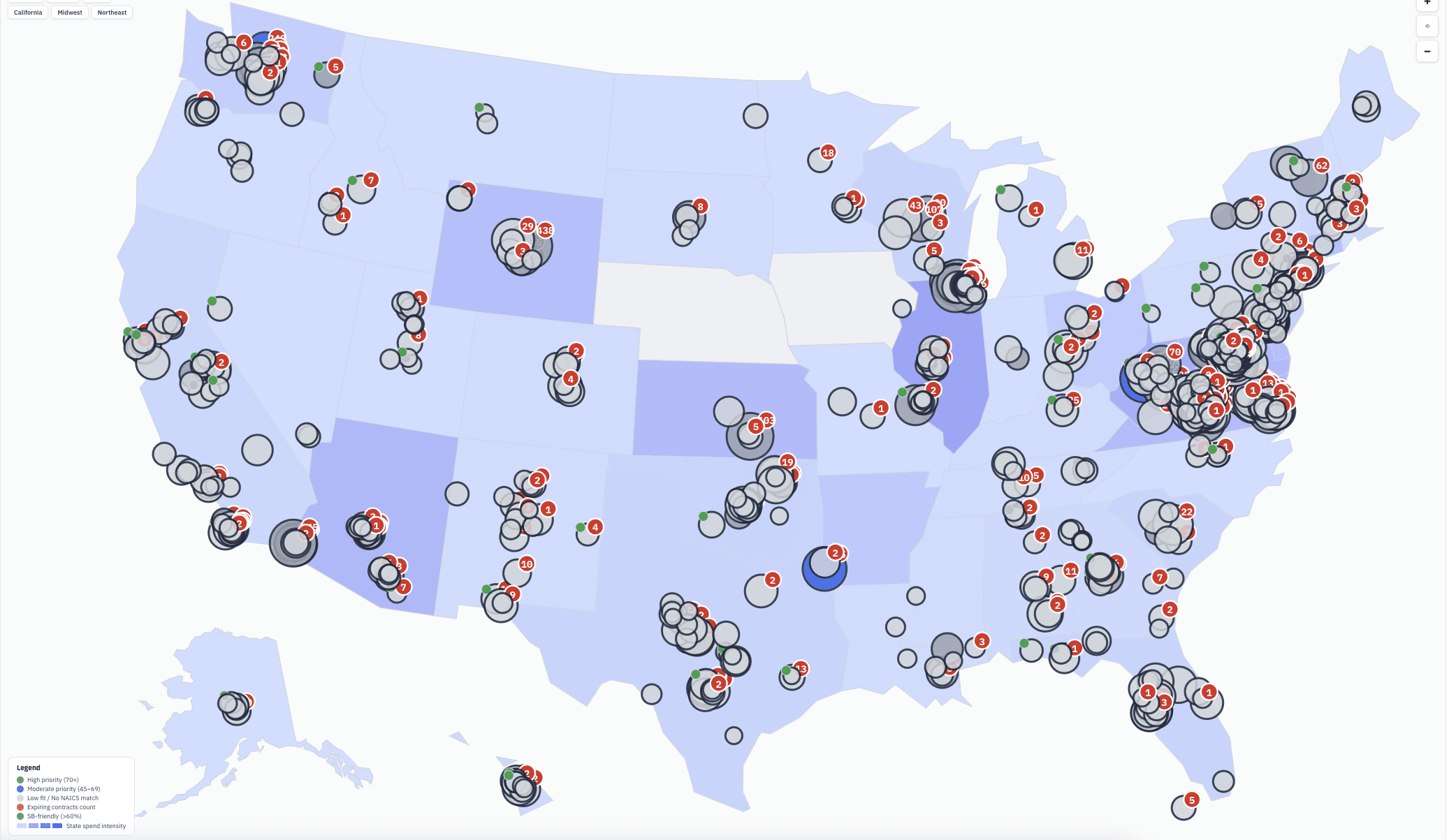
How FedProposal helps: Our expiring contracts dashboard lets you search thousands of federal contracts by agency, NAICS code, set-aside type, and end date. See who holds the contract now, how much they've been paid, and when it ends—so you can start positioning before the RFP ever drops.
Step 4: Research the Incumbent
If the work is a recompete, the incumbent contractor is your most important competitor. Understanding their position helps you decide whether to pursue—and how to win.
Questions worth answering:
Who holds the current contract?
What's the contract ceiling vs. actual spending?
Has funding increased, decreased, or flatlined over time?
Are there subcontractors or teaming partners you could approach?
Declining obligations can signal agency dissatisfaction. Steady or growing spend suggests the incumbent is delivering. Either way, this intelligence shapes your capture strategy.
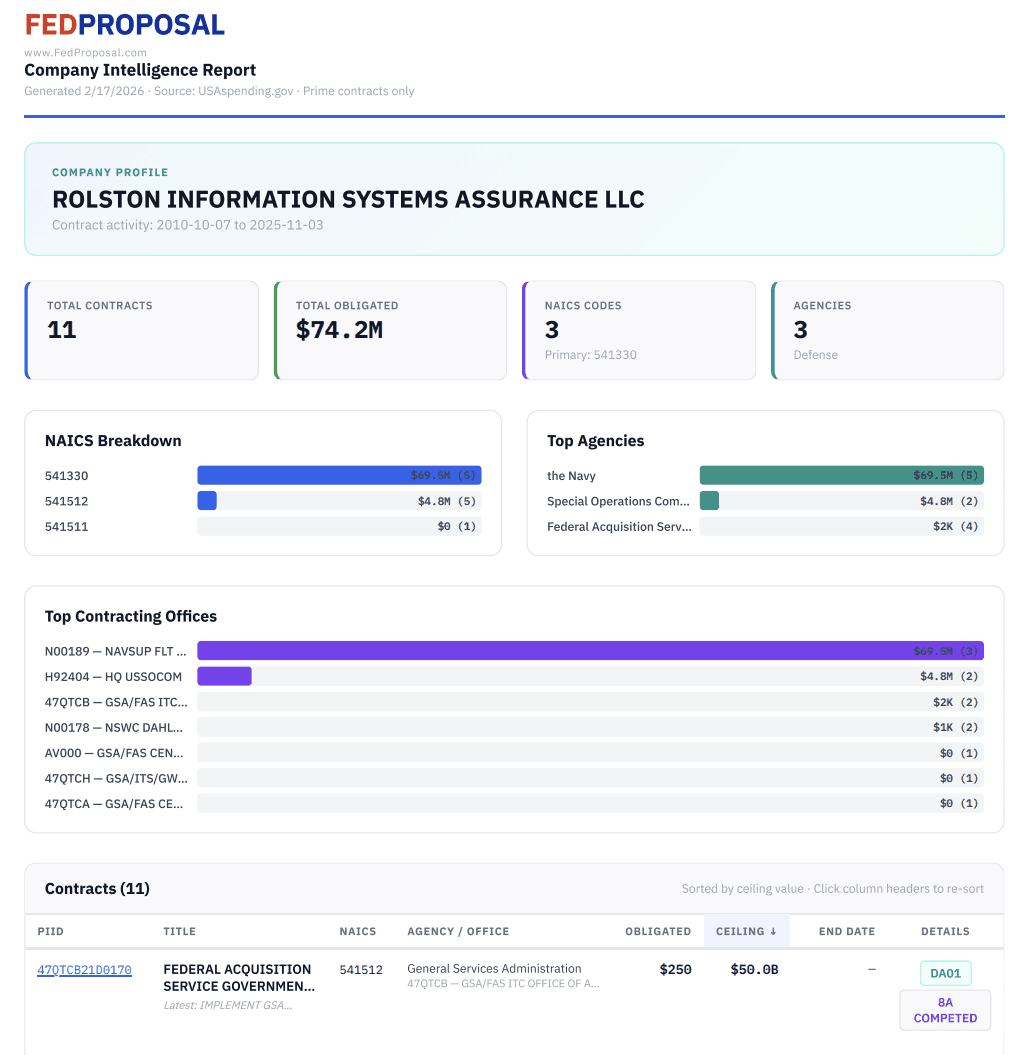
How FedProposal helps: Every contract in our dashboard includes incumbent details, pricing history, and a contract activity timeline showing funding patterns, option years, and modifications. You'll also see contract insights that surface bundled requirements, consolidation risks, and teaming indicators—details that shape whether you prime, sub, or pass.
Step 5: Make Connections Early
Here's where research transitions into relationships. Data gets you informed; relationships get you positioned.
Ways to connect:
Attend industry days and agency outreach events
Introduce yourself to small business specialists at agency OSDBUs
Request capability briefings with program offices
Join industry associations where government buyers participate
These conversations aren't about asking for favors. They're about listening, understanding challenges, and showing how you can solve problems.
How FedProposal helps: We maintain a directory of 43 official agency small business portals—both Defense and civilian—so you can quickly find the right OSDBU contact for your target agencies. We also curate free APEX Accelerator training webinars covering capture, proposals, pricing, and certifications. The research is handled; you focus on building relationships.
Step 6: Ask the Right Questions
When you connect with agency contacts, the quality of your questions matters. Avoid generic asks like "How can I win this contract?" Instead, focus on mission-driven inquiries:
What challenges exist with the current solution?
How does this work align with the agency's strategic priorities?
Are there new compliance requirements influencing the procurement?
Is the agency prioritizing innovation, cost savings, or continuity?
These questions position you as a partner, not just another vendor. And when you've already done your homework on the contract's history, your questions will stand out.
Step 7: Prioritize the Right Opportunities
Not every opportunity is worth chasing. The contractors who win consistently aren't bidding on everything—they're bidding on the right things.
Factors to weigh:
Do you have relevant past performance?
Is the contract size realistic for your company?
Do you have (or can you get) the right vehicle?
Is there a path to unseating the incumbent—or are they entrenched?
Does the agency need your set-aside category to meet their small business goals?
Chasing opportunities you can't win burns resources and frustrates your team.
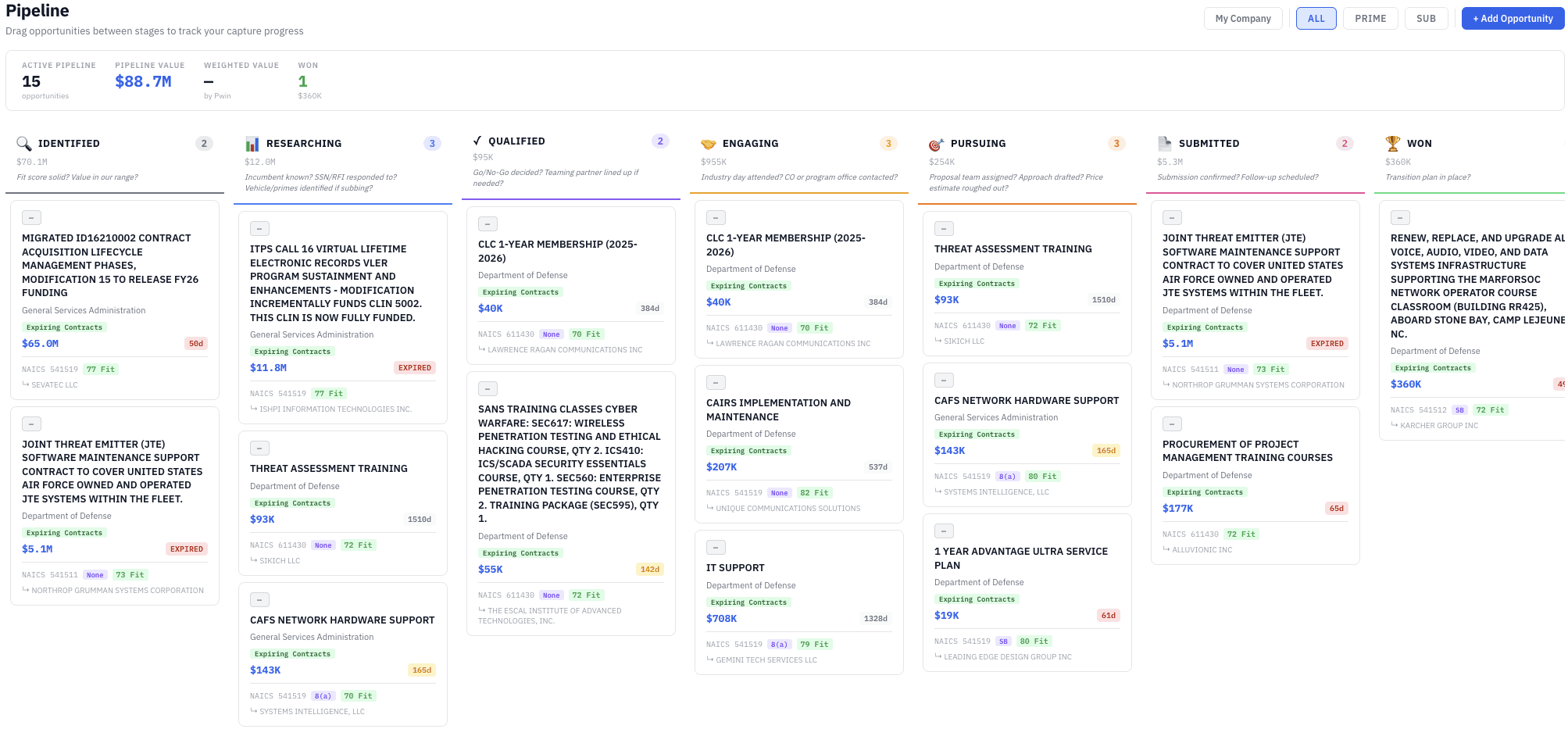
How FedProposal helps: Our AI-powered Fit Score analyzes each contract against your company profile and tells you how well you match. We also show agency small business performance data—see which agencies are falling short on their 8(a), SDVOSB, HUBZone, or WOSB goals, so you can target agencies actively looking for contractors like you.
Step 8: Track What Happened After a Recompete
Sometimes you're late to an opportunity. The contract you were watching already recompeted, and you missed it. Knowing who won—and what they won—helps you prepare for the next cycle.
How FedProposal helps: Our successor contract search lets you find follow-on awards by place of performance, date range, NAICS, and value. See who won when a contract you were tracking got recompeted, and use that intelligence for next time.
Step 9: Build a Repeatable Process
Opportunity research shouldn't be ad hoc. The best BD teams have a repeatable process that ensures every forecasted opportunity gets the same level of attention.
A simple capture checklist:
Check forecast search for upcoming opportunities
Review daily SAM alerts for new postings
Search expiring contracts dashboard for recompetes
Check Fit Score to prioritize pursuits
Research incumbent and contract history
Review agency small business performance data
Identify OSDBU contacts and upcoming events
Decide: prime, sub, or pass
Develop win strategy before the RFP drops
Conclusion: Work Smarter, Not Harder
Winning government contracts is about preparation, insight, and relationships. The research process hasn't changed—but the tools have.
Big primes have dedicated teams and expensive platforms to stay ahead. FedProposal gives small businesses the same intelligence: expiring contracts, incumbent analysis, pricing history, daily SAM alerts matched to your NAICS codes, and AI-powered Fit Scores—all in one dashboard.
Stop wasting time on vague SAM.gov alerts and manual FPDS searches. When the RFP finally drops, your competitors will scramble to make sense of the requirements. You'll already know the landscape, the players, and the agency's priorities.
That's the advantage of doing your homework early—and having the right tools to do it fast.
The Research Problem for Small Businesses
Most small businesses find opportunities too late. By the time an RFP hits SAM.gov, incumbents have been positioning for months—building relationships, shaping requirements, and locking in teaming partners.
Large primes have entire teams dedicated to pipeline development. They subscribe to expensive market intelligence platforms, attend every industry day, and have analysts tracking expiring contracts across dozens of agencies.
Small businesses? Most are stuck with browser tabs, spreadsheets, and SAM.gov saved searches that deliver emails like this:
"Dear Contractor, Your saved search has new updates. Click here to view updated records."
That's it. No details. Now you have to log into SAM.gov, run the search, click through results, and figure out if any of it is even relevant. It could be nothing—and you've just wasted 20 minutes you didn't have.
The research process itself isn't complicated. It's just time-consuming. And time is the one resource small BD teams don't have.
Step 1: Start with Agency Forecasts
Every agency publishes a forecast of upcoming opportunities, usually updated quarterly or annually. These forecasts are your roadmap to where federal spending is heading—and they give you visibility months before anything hits SAM.gov.
What to look for:
Patterns: Which offices consistently need services in your niche?
Timelines: Is the opportunity near-term (6–12 months) or further out?
Contract type and size: Does this fit your past performance and capacity?
The forecast is your entry point. It tells you where to dig deeper—but manually checking dozens of agency forecast pages every quarter isn't realistic for most small teams.
How FedProposal helps: Our forecast search pulls planned acquisitions from 27 federal agencies into one searchable dashboard. Filter by NAICS, fiscal year, agency, or keyword—no more bookmarking agency pages and hoping you remember to check them.
Step 2: Track SAM.gov Without the Frustration
Once opportunities move from forecast to active procurement, they show up on SAM.gov. But staying on top of new postings is a grind.
SAM.gov's saved search alerts are notorious for being vague. You get an email saying something changed, but no context. Then you log in, re-run your search, scroll through results, and try to figure out what's actually new. For busy BD professionals juggling multiple pursuits, this adds up fast.
How FedProposal helps: Our daily SAM.gov alerts deliver new opportunities matching your NAICS codes straight to your inbox every night at 10 PM. You'll see actual details—not a generic "click here" link. Monitor up to 3 NAICS codes and filter by notice type (Sources Sought, Pre-Solicitation, Solicitation) so you only see what matters. No login required. No guessing.
Step 3: Find Expiring Contracts Before They Recompete
The best opportunities aren't on SAM.gov yet. They're contracts ending in 12–18 months—work the government still needs, with incumbents who may or may not be positioned to win again.
Finding these manually means digging through FPDS, cross-referencing contract end dates, and building your own tracking spreadsheet. Most small businesses don't have time for that level of research.
How FedProposal helps: Our expiring contracts dashboard lets you search thousands of federal contracts by agency, NAICS code, set-aside type, and end date. See who holds the contract now, how much they've been paid, and when it ends—so you can start positioning before the RFP ever drops.
Step 4: Research the Incumbent
If the work is a recompete, the incumbent contractor is your most important competitor. Understanding their position helps you decide whether to pursue—and how to win.
Questions worth answering:
Who holds the current contract?
What's the contract ceiling vs. actual spending?
Has funding increased, decreased, or flatlined over time?
Are there subcontractors or teaming partners you could approach?
Declining obligations can signal agency dissatisfaction. Steady or growing spend suggests the incumbent is delivering. Either way, this intelligence shapes your capture strategy.
How FedProposal helps: Every contract in our dashboard includes incumbent details, pricing history, and a contract activity timeline showing funding patterns, option years, and modifications. You'll also see contract insights that surface bundled requirements, consolidation risks, and teaming indicators—details that shape whether you prime, sub, or pass.
Step 5: Make Connections Early
Here's where research transitions into relationships. Data gets you informed; relationships get you positioned.
Ways to connect:
Attend industry days and agency outreach events
Introduce yourself to small business specialists at agency OSDBUs
Request capability briefings with program offices
Join industry associations where government buyers participate
These conversations aren't about asking for favors. They're about listening, understanding challenges, and showing how you can solve problems.
How FedProposal helps: We maintain a directory of 43 official agency small business portals—both Defense and civilian—so you can quickly find the right OSDBU contact for your target agencies. We also curate free APEX Accelerator training webinars covering capture, proposals, pricing, and certifications. The research is handled; you focus on building relationships.
Step 6: Ask the Right Questions
When you connect with agency contacts, the quality of your questions matters. Avoid generic asks like "How can I win this contract?" Instead, focus on mission-driven inquiries:
What challenges exist with the current solution?
How does this work align with the agency's strategic priorities?
Are there new compliance requirements influencing the procurement?
Is the agency prioritizing innovation, cost savings, or continuity?
These questions position you as a partner, not just another vendor. And when you've already done your homework on the contract's history, your questions will stand out.
Step 7: Prioritize the Right Opportunities
Not every opportunity is worth chasing. The contractors who win consistently aren't bidding on everything—they're bidding on the right things.
Factors to weigh:
Do you have relevant past performance?
Is the contract size realistic for your company?
Do you have (or can you get) the right vehicle?
Is there a path to unseating the incumbent—or are they entrenched?
Does the agency need your set-aside category to meet their small business goals?
Chasing opportunities you can't win burns resources and frustrates your team.
How FedProposal helps: Our AI-powered Fit Score analyzes each contract against your company profile and tells you how well you match. We also show agency small business performance data—see which agencies are falling short on their 8(a), SDVOSB, HUBZone, or WOSB goals, so you can target agencies actively looking for contractors like you.
Step 8: Track What Happened After a Recompete
Sometimes you're late to an opportunity. The contract you were watching already recompeted, and you missed it. Knowing who won—and what they won—helps you prepare for the next cycle.
How FedProposal helps: Our successor contract search lets you find follow-on awards by place of performance, date range, NAICS, and value. See who won when a contract you were tracking got recompeted, and use that intelligence for next time.
Step 9: Build a Repeatable Process
Opportunity research shouldn't be ad hoc. The best BD teams have a repeatable process that ensures every forecasted opportunity gets the same level of attention.
A simple capture checklist:
Check forecast search for upcoming opportunities
Review daily SAM alerts for new postings
Search expiring contracts dashboard for recompetes
Check Fit Score to prioritize pursuits
Research incumbent and contract history
Review agency small business performance data
Identify OSDBU contacts and upcoming events
Decide: prime, sub, or pass
Develop win strategy before the RFP drops
Conclusion: Work Smarter, Not Harder
Winning government contracts is about preparation, insight, and relationships. The research process hasn't changed—but the tools have.
Big primes have dedicated teams and expensive platforms to stay ahead. FedProposal gives small businesses the same intelligence: expiring contracts, incumbent analysis, pricing history, daily SAM alerts matched to your NAICS codes, and AI-powered Fit Scores—all in one dashboard.
Stop wasting time on vague SAM.gov alerts and manual FPDS searches. When the RFP finally drops, your competitors will scramble to make sense of the requirements. You'll already know the landscape, the players, and the agency's priorities.
That's the advantage of doing your homework early—and having the right tools to do it fast.